
I was really proud of my post How to Order Records from the GRO (1) until it was pointed out to me that GRO records aren’t original records, they are copies of the original records. The copies were made at the end of each quarter, so they date back to almost the time the original record was created. However, anyone who has ever played broken telephone knows that errors can crop up once information is being copied.
When we are evaluating sources to come to some kind of a conclusion (see my post Sources, Evidence and Proof (2) for more on that) one of the first evaluations we make is whether the source is original or derivative. An original source is, well, original. A derivative source is anything that was copied (transcribed) from that original record. Obviously we can trust the original source more than a derivative one since we know that errors could have been introduced when making the transcription. An exception to this would be extremely good copies, such as a clear microfilm, photocopy or digitized image. We’ll save talking about evaluating the information in the source for another day.
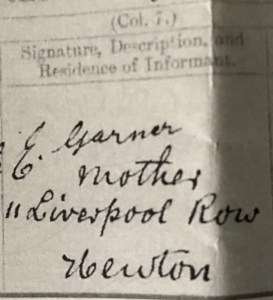
Given this, I decided to send away for the original record. Although the original district was Warrington, the area now falls under the district of St. Helens. 14£ and a few weeks later, I now have a copy of the original birth record. Upon inspection, it doesn’t look like any errors were introduced when the GRO copy was made. Given how similar the copies are, I wouldn’t be surprised if the registrar made the copy very soon after the original was made. In fact, the only difference I can see is the signature of his mother -she had lovely penmanship!

1 Jennifer Wiebe, Jennealogie (https://maltsoda.wordpress.com/2019/09/20/ordering-records-from-the-gro/ : accessed 14 October 2019) “How to Order Records from the GRO.”
2 Jennifer Wiebe, Jennealogie (https://maltsoda.wordpress.com/2019/07/12/sources-evidence-and-proof/: accessed 14 October 2019) “Sources, Evidence and Proof.”
3 Cropped image from St. Helen’s, General Register Office, photocopy of a entry of birth for Herbert Garner, born 30 September 1903; an entry in the register of births in the registration district of Newton in Makerfield, Warrington; digital image 2019, privately held by Jennifer Wiebe, Montreal, Quebec, 2019.
4 Cropped image from England, General Register Office, PDF copy for an entry of birth for Herbert Garner, born 30 September 1903, registered October quarter 1903; a copy of an entry in the certified copy of register of births in the registration district of Newton in Makerfield, Warrington; digital image 2019, privately held by Jennifer Wiebe, Montreal, Quebec, 2019.

 Jennealogie
Leave a reply to Primary vs. Secondary Information | Jennealogie Cancel reply