
A lot of people ask in the Genealogy Squad Facebook Group (1) about genealogy education (usually with a goal of becoming a professional genealogist). Since this is something I’ve looked at, I thought it would be helpful to write a blog post detailing various educational opportunities and how I’m planning on working my way towards becoming a professional genealogist. However, education is something every genealogist should think about, (aspiring) professional or not, so we can keep up with the latest tools and technologies and continue to expand our skills and knowledge.
I’m going to talk about informal educational opportunities, then different certificate programs and finally about certification. This is by no means going to be an exhaustive list; check out Cyndi’s List (2) for more options. One important thing I want to mention before getting started is the difference between getting a certificate and certification. These are two different processes, and while getting a certificate can be a step on your path towards certification, it doesn’t mean you are certified. Likewise, one can be certified without having any certificates in genealogy.
Genealogy can be really expensive, and not everyone has the money or time to invest in formal courses. Fortunately, there are a lot of learning opportunities available for free or for much less expensive than a formal course. For instance, there are a lot of genealogy blogs and webinars that can be read or watched for free. Even Legacy Family Tree Webinars (3) which offers webinars for a fee, has webinars that are free, and some webinars are free as they are presented and for a limited time after. FamilySearch has classes and webinars (4) and Ancestry has an Academy (5) full of articles and videos to watch. Useful informal learning opportunities available at a cost include study groups such as NGSQ study group (6) (there is no fee for the group itself, but you will need to join the NGS (7) in order to participate -and the NGS also offers classes with its membership, some for free, some at a cost) or ProGen (8) study group (if you are thinking of becoming a professional genealogist, you will definitely want to participate in this one). There are many books and magazines you can buy or subscribe to, depending on your area of interest. Membership in a local genealogy society may not be free, but they may have access to many books, journals and other tools available for free as well as offer lectures and conferences in your area of interest. Attending larger conferences, like Rootstech (9) and NGS (10) can also be a good educational opportunity. For people who are not near any societies or who would find it difficult to travel to a conference, there is even a Virtual Genealogical Association (11).
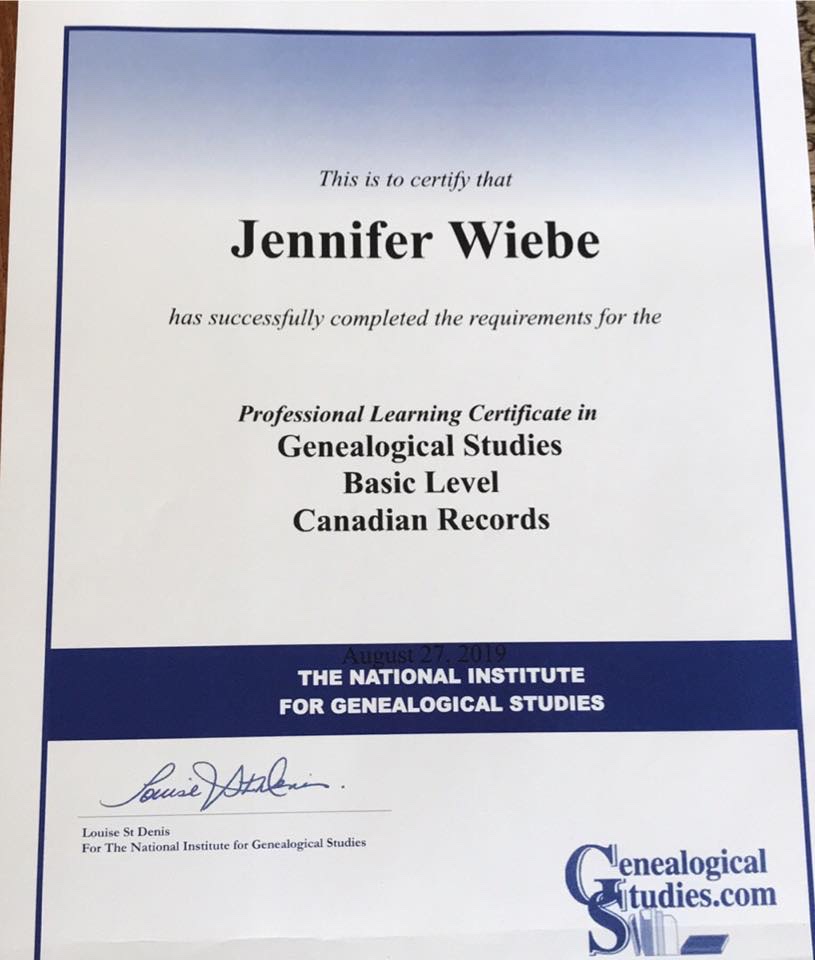
When we start to think about more formal coursework, the cost and time investment increases. There are week long intensives, either in person or virtual, such as SLIG (12) GRIP (13) and IGHR (14). One of the reasons why people would want to take a certificate course (either online or in person) is that you don’t know what you don’t know. While a person could piece together enough courses to gain a deep understanding of genealogy topics, it’s obviously a lot easier to have the courses laid out for you and know that a respected institution will cover all the topics you need to know. I will mention two such Institutes, although many exist: Boston University (15) offers an intensive 15 week online course, and the National Institute for Genealogical Studies (16) is where I’m working towards a certificate in Canadian records (40 courses). If you have 15 weeks to spare, I’ve heard good things about the BU course. While it will take me much, much longer to finish my courses at NIGS, I like that I can do them at my own pace (which is currently one course per month, although most courses allow two months for completion, and you can do as many courses at a time as you can handle).
Switching gears a little, I’m going to talk about certification. It bears mentioning again that certification is a different process than getting a certificate. Getting a certificate is a learning process; certification is a process that can pursued once enough genealogical knowledge has been obtained. There are a few certifying bodies; the two big ones are BCG (18) and ICAPGen (19). Locally, I also have the Fédération québécoise des sociétés de généalogie (20) which certifies Quebec genealogists to do French-Canadian research. While certification isn’t necessary to do genealogy work professionally, it does ensure that a genealogist meets certain standards, as a portfolio has to be submitted and judged to meet the requirements before certification is granted. For the genealogist, it can be point of pride; for consumers, it can be an easy way to ensure you are hiring someone with expertise. One day I’d like to be certified by the BCG, and anyone who’s interested in exploring BCG certification should consider taking the Certification Discussion Group (21) course. I’m currently taking it even though certification is a long way off (and I’ll probably take the ProGen course before as well). I’m learning a lot about the requirements so I can prepare myself well in advance and tailor my education (formal and informal) to be more prepared when I’m ready to pursue certification.
I think it’s really wonderful that there are so many different ways we can educate ourselves in this day and age. Whether I do something in person or online, with a group or on my own, everyday I can achieve my goal of going to bed a little less stupid. If you value this as well, I hope this post was helpful in pointing out opportunities to you. Let me know in the comments about your experiences with both formal and informal genealogy education!
1 Genealogy Squad (https://www.facebook.com/groups/genealogysquad/ : accessed 10 October 2019).
2 Cyndi Howells, Cyndi’s List (https://www.cyndislist.com/education/ : accessed 10 October 2019) “Education (Genealogical).”
3 Legacy Family Tree Webinars (https://familytreewebinars.com/index.php : accessed 10 October 2019).
4 Family Search (https://www.familysearch.org/wiki/en/Family_History_Library_Classes_and_Webinars : accessed 10 October 2019) “Family History Library Classes and Webinars.”
5 Ancestry (https://www.ancestry.com/academy/courses/recommended : accessed 10 October 2019).
6 The NGSQ Study Group (https://ngsqstudygroup.com/ : accessed 10 October 2019).
7 National Genealogical Society (https://www.ngsgenealogy.org/ : accessed 10 October 2019).
8 ProGen Study Groups (https://progenstudy.org/ : accessed 10 October 2019).
9 Rootstech (https://www.rootstech.org/ : accessed 10 October 2019).
10 National Genealogical Society (https://conference.ngsgenealogy.org/ : accessed 10 October 2019), “Conference.”
11 Virtual Genealogical Association (https://virtualgenealogy.org/ : accessed 10 October 2019).
12 Salt Lake Institute of Genealogy (https://slig.ugagenealogy.org/index.php : accessed 10 October 2019).
13 Genealogical Research Institute of Pittsburgh (https://www.gripitt.org/ : accessed 10 October 2019).
14 Georgia Genealogical Society, Institute of Genealogy and Historical Research (https://ighr.gagensociety.org/ : accessed 10 October 2019).
15 Boston University, Genealogy Studies Program (https://genealogyonline.bu.edu/certificate : accessed 10 October 2019) “Certificate Course.”
16 National Institute for Genealogical Studies (https://www.genealogicalstudies.com/ : accessed 10 October 2019).
17 National Institute for Genealogical Studies, Basic Level Professional Learning Certificate in Canadian Records, 2019, digital image 2019, privately held by Jennifer Wiebe, Montreal, Quebec, 2019.
18 Board for Certification of Genealogists (https://www.bcgcertification.org/ : accessed 10 October 2019).
19 International Commission for the Accreditation of Professional Genealogists (https://www.icapgen.org/ : accessed 10 October 2019).
20 Fédération québécoise des sociétés de généalogie (http://federationgenealogie.qc.ca/bureau-attestation/bqacg-comp-filiation : accessed 10 October 2019) “Attestation.”
21 Jill Morelli, Our Portfolio Journey (https://thecdgseries.wordpress.com/home/ : accessed 10 October 2019).

