
This post is a follow-up post to my post Genealogy Education and Certification (1). I again want to reiterate the difference between a “certificate” and a “certification,” especially since I have seen people who have acquired a certificate referring to themselves as certified. A certificate is proof of education. While it is meaningful in that the person fulfilled the educational requirements necessary to receive the certificate, it doesn’t tell you much about their competence beyond that. I am reminded of the joke, “What do you call a medical student who graduated with a D? —Doctor.” After gaining enough education and experience in a field, a person may want to apply for certification. Think of the difference between law school and being a lawyer. One gains their “certificate” by finishing law school, and one becomes “certified” as a lawyer after passing the bar. While different certifying bodies have different processes for obtaining certification, in genealogy this involves an exam and/or submission of work which is reviewed by those already deemed competent in the field. There are two main certifying bodies: The Board for Certification of Genealogists (2) and ICAPGen (3). Keep in mind that these are certifying bodies for genealogy, and while genetic genealogy is a part of genealogy and may be used in the certifying process, it isn’t mandatory and so a genealogical certification is meaningless when it comes to assessing competence in genetic genealogy. A search of the United States patent office (4) for the term “genetic genealogist” shows that the BCG filed a claim to trademark the term “Certified Genetic Genealogist” in September 2022. While this may indicate plans to develop a certification process for genetic genealogists, it is more likely that they are trying to protect a term they view as their intellectual property.
So, how to develop competency in genetic genealogy? Like genealogy, there are many avenues, both formal and informal. If you’ve yet to take a DNA test, that’s definitely the place to start, as there is so much you can learn just by working with your own DNA. Personally, I’m very grateful that the first test I did was the now-defunct National Geographic one, since it could be uploaded to FTDNA. It offers a lot more tools than Ancestry to analyze your DNA, which meant I had a lot of learning to do. A DNA match there asked me if I had uploaded to Gedmatch, which took me down another rabbit hole of trying to understand the information from there. I highly recommend no matter where you test that you explore what each company has to offer. Great instructions here (5) on how to download your DNA from one place and upload it to another. All of these companies offer help pages or learning centers that can tell you about working with their particular tools.
There are a lot of great books on genetic genealogy. The Family Tree Guide to DNA Testing and Genetic Genealogy by Blaine Bettinger (6) is a great book for beginners to start with. It goes over all the basics of different types of DNA and includes information about some third party tools. A chapter on complex questions will give you enough knowledge to pursue further education.
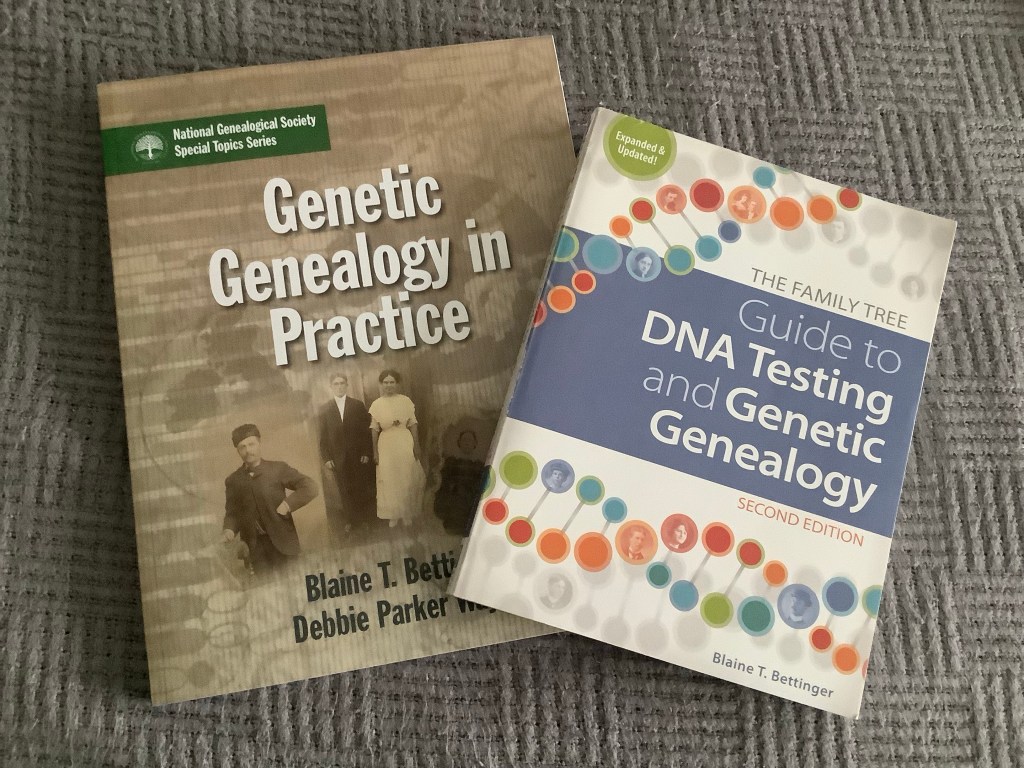
Genetic Genealogy in Practice by Blaine Bettinger and Debbie Parker Wayne (8) is another good book. It has questions at the end of each chapter to apply the knowledge you’ve learned so it becomes practical.
Advanced Genetic Genealogy: Techniques and Case Studies edited by Debbie Parker Wayne (9) is obviously an advanced book, but definitely one to add to your collection if you’ve gleaned all you can from the other two.
Study groups may exist for these books, and if they don’t, you should consider creating one yourself! Reading and doing assignments as a group can be a great way to motivate yourself to read a book that would otherwise sit on a shelf. Family Locket Genealogists have a study group called Research Like a Pro with DNA Study Group (10). It’s not based on a book, but can also be a great way to learn.
Blogs are another great way to gain genetic genealogy knowledge. If I can toot my own horn here, there are lots of posts (11) about DNA on this blog, many at a beginner level. If there’s something you’d like to understand but don’t see it here, feel free to leave a comment! I started this blog as a place to refer people because I saw the same questions being asked over and over again. I love answering questions! Other blogs for beginners which I really like are Roberta Estes’ DNAeXplained (12) and Leah Larkin’s The DNA Geek (13). A tip I learned from the book Organize Your Genealogy (14) is to use the Feedly (15) app to keep track of all the blogs I follow. That way I only have to visit one place to view all the new posts!
Facebook groups are also an invaluable source, and great for asking questions. I have mentioned Genetic Genealogy Tips and Techniques (16) many times here; it’s one of my favourites. Also check out user groups for sites like Gedmatch (17), or any other third-party tool you want to learn more about, such as DNA Painter: What Are the Odds? (WATO) (18).
If you like watching videos, YouTube can be a great place to learn. Family History Fanatics (19) has a YouTube channel chock-full of videos on all topics, including DNA. A subscription to Legacy Family Tree Webinars (20) is also a great way to watch and learn. Even without a subscription, the webinars are usually free for the first week after they come out, and there are a number of videos on their site that remain free.
Conferences like Rootstech (21) and NGS (22) may offer workshops or seminars on genetic genealogy. Check out conference keeper (23) to see what’s available.
Institutes, either in person or virtual, such as SLIG (24), GRIP (25), and IGHR (26) also offer courses in genetic genealogy. I did Advanced DNA Evidence virtually (27) in 2021 and it was a great experience!
Finally, an incomplete listing of various courses on genetic genealogy offered online. Blaine Bettinger offers DNA education through his subscription site DNA Central (28). DNA Adoption (29) offers a free intro class and then other paid classes on DNA. If you’re interested in helping adoptees (or are an adoptee looking for answers) it is a great place to learn the techniques. The National Genealogical Society has a paid course called Understanding and Using DNA Test Results (30). The University of Strathclyde (31) offers short courses on genetic genealogy. The International Institute for Genealogical Studies (formerly known as the National Institute for Genealogical Studies) has a DNA and Genetic Genealogy Certificate (32).
I hope this round-up of resources has been helpful! If I’ve missed something that you consider to be an essential resource, let me know in the comments!
1) Jennifer Wiebe, “Genealogy Education and Certification,” Jennealogie (https://maltsoda.wordpress.com/2019/10/10/genealogy-education-and-certification/ : accessed 2 February 2023).
2) Board for Certification of Genealogists (https://www.bcgcertification.org/ : accessed 2 February 2023).
3) International Commission for the Accreditation of Professional Genealogists (https://www.icapgen.org/ : accessed 2 February 2023).
4) “Trademark Electronic Search System (TESS),” United States Patent and Trademark Office (https://tmsearch.uspto.gov : accessed 2 February 2023).
5) Roberta Estes, “DNA File Upload-Download and Transfer Instructions to and from DNA Testing Companies,” DNAeXplained (https://dna-explained.com/2019/11/04/dna-file-upload-download-and-transfer-instructions-to-and-from-dna-testing-companies/ : accessed 2 February 2023).
6) Blaine Bettinger, The Family Tree Guide to DNA Testing and Genetic Genealogy (Second Edition) (USA : Family Tree Books, 2019).
7) Jennifer Wiebe, digital photo, great books, February 2023, author’s files.
8) Blaine Bettinger and Debbie Parker Wayne, Genetic Genealogy in Practice (Arlington, Virginia : National Genealogical Society, 2016).
9) Debbie Parker Wayne, ed., Advanced Genetic Genealogy: Techniques and Case Studies (Cushing, Tex.: Wayne Research, 2019).
10) Diana Elder and Nicole Dyer, “Research Like a Pro® with DNA Study Group,” Family Locket Genealogists (https://familylocket.com/services/research-like-a-pro-with-dna-study-group/ : accessed 2 February 2023).
11) Jennifer Wiebe, “Category: DNA” Jennealogie (https://maltsoda.wordpress.com/category/dna/ : accessed 2 February 2023).
12) Roberta Estes, DNAeXplained (https://dna-explained.com/ : accessed 2 February 2023).
13) Leah Larkin, The DNA Geek (https://thednageek.com/ : accessed 2 February 2023).
14) Jennifer Wiebe, “Book Review: Organize Your Genealogy,” Jennealogie (https://maltsoda.wordpress.com/2019/08/08/book-review-organize-your-genealogy/ : accessed 2 February 2023).
15) Feedly (https://feedly.com/ : accessed 2 February 2023).
16) “Genetic Genealogy Tips & Techniques,” Facebook (https://www.facebook.com/groups/geneticgenealogytipsandtechniques/ : accessed 2 February 2023).
17) “GEDmatch.com User Group,” Facebook (https://www.facebook.com/groups/405531739562579 : accessed 2 February 2023).
18) “DNA Painter: What Are the Odds? (WATO),” Facebook (https://www.facebook.com/groups/244344539465504 : accessed 2 February 2023).
19) “Family History Fanatics,” Youtube (https://www.youtube.com/channel/UCmkKepHoafldMRZ4UNt0Akw : accessed 2 February 2023).
20) Legacy Family Tree Webinars (https://familytreewebinars.com/index.php : accessed 2 February 2023).
21) Rootstech (https://www.rootstech.org/ : accessed 2 February 2023).
22) National Genealogical Society (https://conference.ngsgenealogy.org/ : accessed 2 February 2023), “Conference.”
23) Conference Keeper (https://conferencekeeper.org/ : accessed 2 February 2023).
24) Salt Lake Institute of Genealogy (https://slig.ugagenealogy.org/index.php : accessed 2 February 2023).
25) Genealogical Research Institute of Pittsburgh (https://www.gripitt.org/ : accessed 2 February 2023).
26) Georgia Genealogical Society, Institute of Genealogy and Historical Research (https://ighr.gagensociety.org/ : accessed 2 February 2023).
27) Jennifer Wiebe, “I went to GRIP!,” Jennealogie (https://maltsoda.wordpress.com/2021/07/23/i-went-to-grip/ : accessed 2 February 2023).
28) Blaine Bettinger, DNA Central (https://dna-central.com/ : accessed 2 February 2023).
29) “Classes,” DNA Adoption (https://dnaadoption.org/classes/ : accessed 2 February 2023).
30) “Understanding and Using DNA Test Results,” National Genealogical Society (https://www.ngsgenealogy.org/cgs/understanding-and-using-dna-test-results/ : accessed 2 February 2023).
31) “Centre for Lifelong Learning: Genetic Genealogy Courses & Research,” University of Strathclyde (https://www.strath.ac.uk/studywithus/centreforlifelonglearning/genealogy/geneticgenealogycoursesresearch/ : accessed 2 February 2023).
32) “DNA and Genetic Genealogy Certificate,” International Institute for Genealogical Studies (https://www.genealogicalstudies.com/eng/courses.asp?certificateID=27 : accessed 2 February 2023).


Leave a Reply