
I talked in a previous post (1) about how Familial DNA Searching is not the same as Forensic Investigative Genetic Genealogy (FIGG) but how they are often conflated. I posted on LinkedIn (2) about how FIGG goes by a few different names, and mentioned that it is also conflated with Forensic Genealogy. So I thought I’d write about the differences between these names and why it matters.
When the media writes about FIGG, they often call it forensic genealogy, writing that this is a new field (4). However, if you look at this article from 2013 (5), you can see that Forensic Genealogy existed long before the announcement of the arrest of the Golden State Killer in April 2018, which is often seen as the beginning of the field.
As the article mentions, Forensic Genealogy is genealogy with legal implications, such as heir searching. These genealogists are often called to write legally binding affidavits and to testify in court. While some may work with DNA, this kind of work was being done long before the advent of Direct-To-Consumer (DTC) DNA tests.
Investigative Genetic Genealogy (IGG) was a term coined by Paul Holes, the detective on the Golden State Killer case, in this article (6) in 2019. This term was adopted by prominent members of the field and became the default term for work done with unknown DNA belonging either to a suspect in a criminal case or unidentified human remains (UHR).
However, some people felt that since this DNA was inherently forensic in nature, the word forensic should appear somewhere in the title, and began to call it Forensic Genetic Genealogy. Some liked the use of the word Investigative, and since it helped to further distinguish it from Forensic Genealogy, began to call it Forensic Investigative Genetic Genealogy (FIGG).
So here we have two fields, one with multiple names, which looks kind of like this:
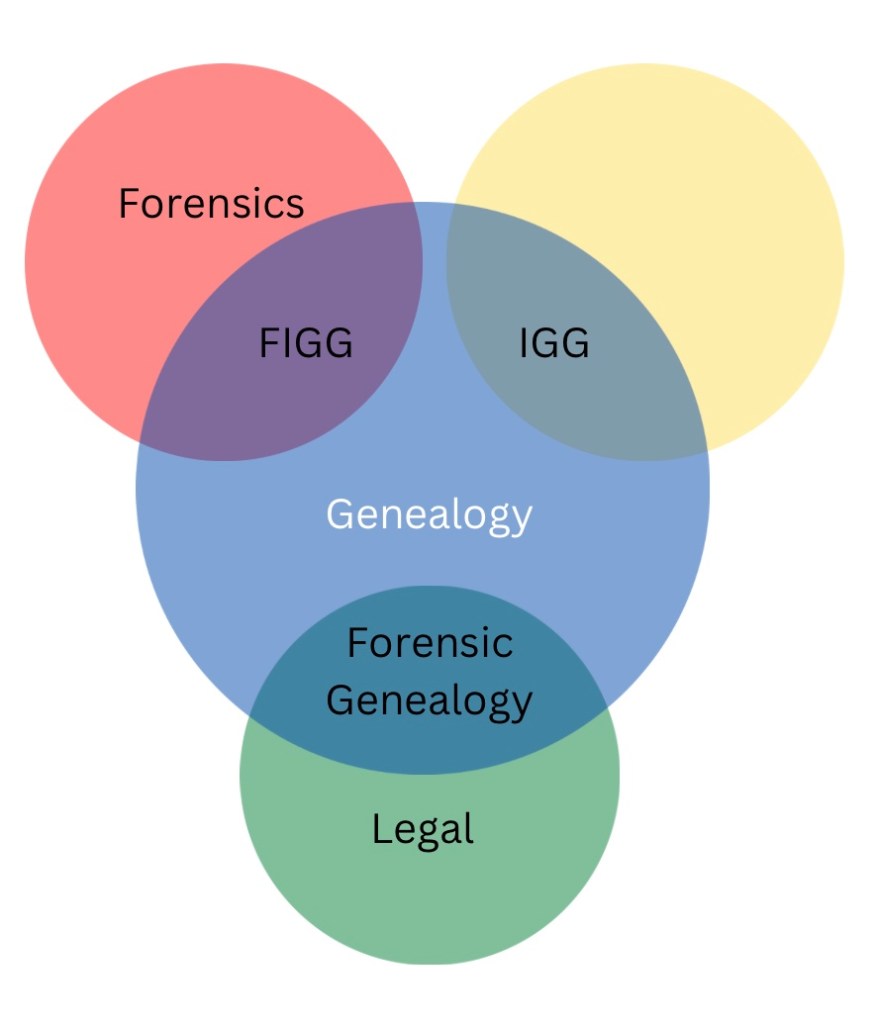
Keep in mind that IGG and FIGG are representing the same field. The difference is that FIGG sees itself as part of the forensic process, whereas IGG wishes to distinguish itself from the forensic sciences (8). However, both IGG and FIGG practitioners are adamant they they are not Forensic Genealogists. While researching this, I began to question why. After all, the forensic sciences are a part of the legal system, why shouldn’t FIGG be a subset of Forensic Genealogy?
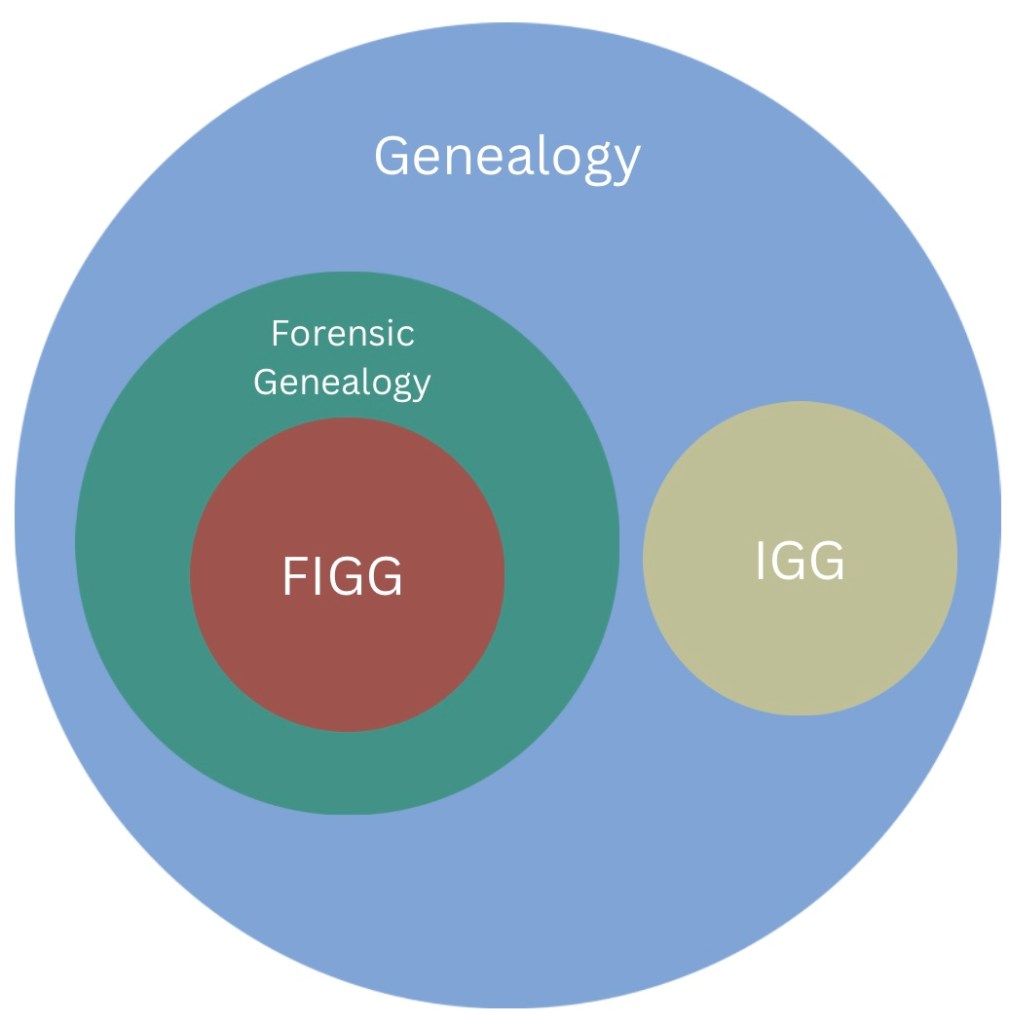
In the end, it may not matter. What the field will be called as defined in legal documents will certainly influence the name. The DOJ in their interim guidelines (10) calls it “Forensic Genetic Genealogical DNA Analysis and Searching (‘FGGS’).” More likely, what the media calls it will enter public consciousness, and the shorter “forensic genealogy” may win out.
So why does it matter what the field is called? For one, if legislation is written about this field, it should be able to accurately describe the work that we do. Further, if the field falls under the branch of forensics, then it is believed that it should be regulated by forensics. The proponents of IGG (11) do not believe that this work should be regulated by forensics. It’s too long to go into details here, but it’s definitely a topic I hope to blog about in the near future.
I will also add that the whole name game isn’t just relevant to English. Given the international nature of this work, we need to develop a vocabulary to talk about this field in all languages.
Étant donné la nécessité de parler du domaine à l’international, nous avons besoin de développer le vocabulaire pour parler de ce domaine dans toutes les langues.
En français, c’est compliqué. Ce serait plus simple si le mot « forensic » était « forensique, » mais ce n’est même pas un faux ami, le mot n’existe tout simplement pas. Google voudrait traduire « forensic » par légal ou médico-légal. Le laboratoire GRC de Montréal s’appelle « Le Laboratoire de sciences judiciaires et de médecine légale du Québec (LSJML).» Cela me laisse me demander comment on traduit « FIGG » — Généalogie Génétique d’Investigation Médico-Légale?
It’s been really fascinating watching this field grow since its inception. This Spring will be 5 years since the announcement of GSK, and we’re only getting started. We’re seeing the beginning of much-needed legislation and regulation, not all of it well-written, which is why conversations like this one are so necessary. I would really love to be a part of the discussion to help create legislation where I live, so we can continue to benefit from the good this field can bring.
1) Jennifer Wiebe, “Familial DNA Searching vs. Forensic Investigative Genetic Genealogy,” Jennealogie (https://maltsoda.wordpress.com/2022/11/15/familial-dna-searching-vs-forensic-investigative-genetic-genealogy/ : accessed 5 December 2022).
2) “Jennifer Wiebe,” LinkedIn (https://www.linkedin.com/in/jennifer-w-64aa52162/ : accessed 5 December 2022).
3) Jennifer Wiebe, digital photo, what’s in a name, November 2022, author’s files.
4) Raffi Khatchadourian, “How Your Family Tree Could Catch a Killer,” The New Yorker (https://www.newyorker.com/magazine/2021/11/22/how-your-family-tree-could-catch-a-killer : accessed 5 December 2022).
5) Sunny Jane Morton “5 Questions with a Forensic Genealogist,” Family Tree Magazine (https://familytreemagazine.com/dna/5-questions-forensic-genealogist/ : accessed 5 December 2022).
6) Tara Luther, “To Catch a Predator: An Interview with Paul Holes,” The ISHI Report (https://promega.foleon.com/theishireport/april-2019-final/to-catch-a-predator-an-interview-with-paul-holes/ : accessed 5 December 2022).
7) Jennifer Wiebe, digital photo, venn diagram, December 2022, author’s files.
8) David Gurney et al., “The need for standards and certification for investigative genetic genealogy, and a notice of action,” PubMed (https://pubmed.ncbi.nlm.nih.gov/36257095/ : accessed 5 December 2022).
The full text of the paper can be found: David Gurney et al., “The need for standards and certification for investigative genetic genealogy, and a notice of action,” Forensic Science International 341 (December 2022), 111495.
9) Jennifer Wiebe, digital photo, venn diagram 2, December 2022, author’s files.
10) “Interim Policy: Forensic Genetic Genealogical DNA Analysis and Searching,” United States Department of Justice (https://www.justice.gov/media/1025866/dl?inline= : accessed 5 December 2022).
11) Gurney et al., “The need for standards.”

 Jennealogie
Leave a reply to Law Enforcement is not using AncestryDNA | Jennealogie Cancel reply