
More accurately, GRIP came to me, virtually. I mentioned the Genealogical Research Institute of Pittsburgh (GRIP) (1) in my post Genealogy Education and Certification (2). So when the opportunity to sign up for its virtual offerings came up, I was excited that I was able to get into a class for both the June and July sessions.
The first session was Mastering Genealogical Documentation with Tom Jones. As I mentioned in Cite Your Sources (3), citations are a key component of solid genealogy work. They are also the bane of my existence. I have been making an effort to add citations to all of my blog posts, and it adds tremendously to the work of blogging. I’ve also been trying to work on my own “house style” (because consistency is key) and write a citation for all the documents I have so that when I want to write something, adding citations to it won’t be much more complicated than cut and paste.
The class is based on Dr. Jones’ book Mastering Genealogical Documentation (4), and it was phenomenal. First of all, Dr. Jones is an amazing teacher. I will definitely be looking to take more classes taught by him. He has a remarkable knowledge base, and is incredibly patient and kind. No matter how many questions you asked, or how many answers you got wrong – and trust me, I had a lot of both – he never made me feel dumb when responding to me.
Confession: I own Dr. Jones’ book, but I have never read it. It is a fantastic resource, with very clear explanations and exercises at the end of each chapter. If you were never able to take this class, you could do very well for yourself just reading the book and doing the exercises. The advantage of the class, of course, is the ability to ask questions as you go along and to have classmates ask the questions you never even thought to ask (and I was fortunate to have brilliant classmates who asked so many good questions). The homework assignments in the course were amazing as well – they really solidified the learning that we did each day. I feel like I have a much more solid view of the art of constructing citations. Instead of just providing a template, we were informed of all the different components that go into making a citation so we can carefully consider the source (another reason for citations that I glossed over in my blog post). I was pleased to see that a few of my classmates didn’t have things like certification or publication in mind when taking this course. They recognized, as I do, that citations are fundamental to good genealogy. I am proud to be a part of a field that holds such high standards for itself!
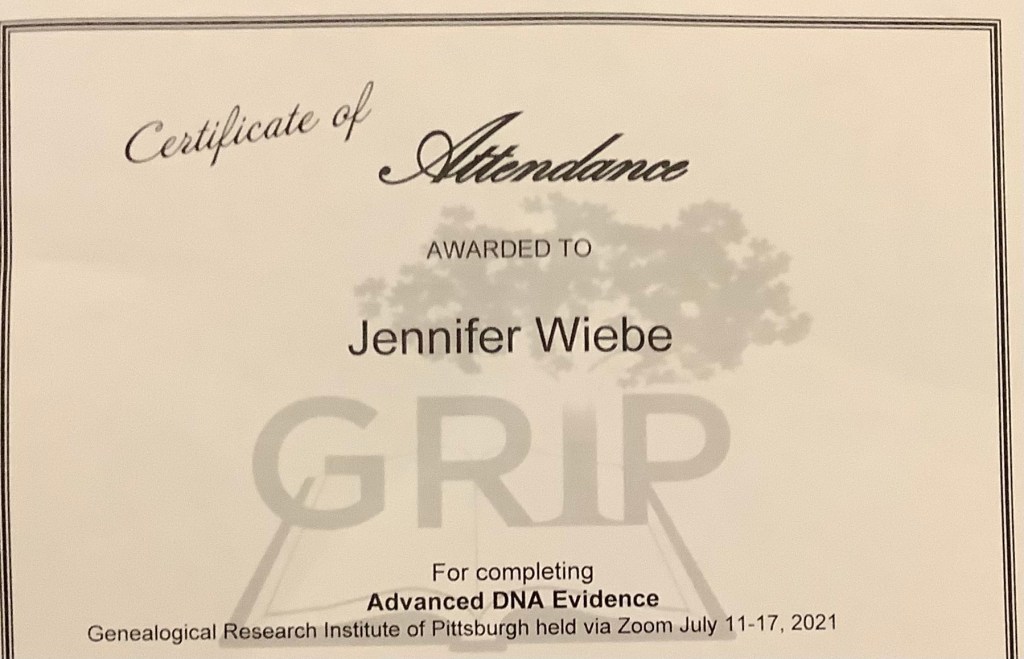
The second session was Advanced DNA Evidence, coordinated by Blaine Bettinger, with additional instructors Angie Bush and Karen Stanbary, CG. Part of me worried that by not taking the basic DNA first, that I would be a bit lost taking the advanced DNA, but I was also concerned that I would be bored even in the advanced course, given that I work with DNA evidence almost every day. I was glad to be wrong on both counts.
Again the instructors were fabulous and I learned a lot, even a new technique which I hope to write about in the future (visual phasing requires 3 siblings, so my first order to business is to get the required DNA for it). I really appreciated seeing how DNA evidence goes hand in hand with documentary evidence, no matter how much some people try to separate the two. The sessions on citing DNA evidence coupled nicely with the previous session’s course, and looking at the case studies showed me that while my DNA knowledge base may be advanced, if I want to be able to use it (to one day be certified or to publish, for example), I really need to level up my other skills. One of my classmates mentioned a new tool for organizing genealogy, and I hope to write about that soon!
Overall I was extremely impressed with virtual GRIP. The courses went so smoothly with hardly any technical hiccups, which is a huge accomplishment. I’m sure a great deal of that credit belongs to the tech hosts in each meeting, who made sure everyone was able to get into the ZOOM meetings, kept people muted when they needed to be, and other things I didn’t notice because it all went so well. My one complaint about the virtual experience has nothing to do with the organization but with my own situation: when you’re at home, you get distracted by things at home. Personally I was logging into meetings on my phone at a certain point each day to go pick my kids up from school and camp, doing my best to listen and follow along while driving. At the end of the day, when my brain was completely taxed and I still had homework to do, I then had to make supper and do other home stuff. If I was actually in Pittsburgh, I could focus 100% on my course, and get supper made for me. Something to consider if they continue to have virtual offerings when in-person learning begins again.
Continuing education is fundamental to the field of genealogy and I was heartened to see veteran genealogists in my courses. I would encourage everyone who has the opportunity to do so to attend GRIP!
1) Genealogical Research Institute of Pittsburgh (https://www.gripitt.org/: accessed 23 July 2021).
2) Jennifer Wiebe, “Genealogy Education and Certification,” Jennealogie (https://maltsoda.wordpress.com/2019/10/10/genealogy-education-and-certification/: accessed 22 July 2021).
3) Jennifer Wiebe, “Cite Your Sources,” Jennealogie (https://maltsoda.wordpress.com/2019/05/24/cite-your-sources/: accessed 22 July 2021).
4) Tom Jones, Mastering Genealogical Documentation (Arlington, Virginia: National Genealogical Society, 2017).
5) Jennifer Wiebe, digital photo, GRIP Advanced DNA Certificate of Attendance, July 2021, author’s files.


 Jennealogie
Leave a reply to Terry Cancel reply