
Most people know GPS as “global positioning system,” the device in their phone/car that gets them where they’re going. Today I’m going to write about the acronym as it applies to genealogy: it stands for Genealogical Proof Standard. While it will get you where you’re going if you follow it —much like your car’s GPS — since I was using the baking analogy in my last post (1) about improving your genealogy skills, that’s the analogy I’m going to use here.
While the GPS is used by the Board for Certification of Genealogists (2) as a way to evaluate genealogists’ work when they apply for certification, it is not just a tool for professionals or those who want to work at a professional level. Even if we consider genealogy “just” a hobby, we still want to end up with good results! The same is true in the baking world.
As a hobby baker, I want to make things that taste good, even if I don’t want to sell my cakes or win baking competitions. I could say that I just want to enjoy the process of baking, without worrying about getting weighted down with baking standards, but that sounds ridiculous. Anyone who has ever tried to bake something knows the importance of following a recipe and measuring ingredients properly — my first experience with this was that time as a child when I accidentally used 1/4 c. of salt instead of 1/4 tsp. Thankfully I’m a much better baker now.
The GPS is not there to make our work more onerous but to make sure our results are good, much like a recipe is not there to get in our way but to ensure our results are edible. The product of genealogy is like the product of baking. If our sources are ingredients, then the GPS is the recipe that tells us how to evaluate those ingredients and use them for the best outcome. Genealogy isn’t about collecting as many sources as we can any more than baking is about collecting as many ingredients as we can. Nor is genealogy about creating the biggest or longest family tree we can any more than baking is about making the biggest cake, without paying any heed to the ingredients that go into it.
If you’re convinced that following a recipe is a good way to ensure success, here’s the recipe for good genealogy. The GPS has 5 components (3):
1. Reasonably exhaustive research. This means we looked in all the places where we would expect to find sources. I like that the word “exhaustive” is tempered by the word “reasonably.”
2. Complete and accurate source citations. I’ve talked about why citing your sources (4) is important, but it’s also important to note that the easiest way to know if someone has successfully attained the first criteria is by reviewing their citations.
3. Analysis and correlation of the collected information. One of the first things to do is to comb through the sources and check if they’re derivative or original (5). There are other criteria for evaluating sources that I hope to discuss in future posts.
4. Resolution of conflicting evidence. Do all the sources agree? If they don’t, can you satisfactorily resolve any conflicts?
5. Well-reasoned, written conclusion. This is the final product, our cake. It doesn’t have to be fancy, academic or ready for publication. It just has to be written. Otherwise we are leaving our research as a jumbled collection of ingredients for the next person to pick up, which is a real shame if we’ve gone to all the trouble of following the first four steps.
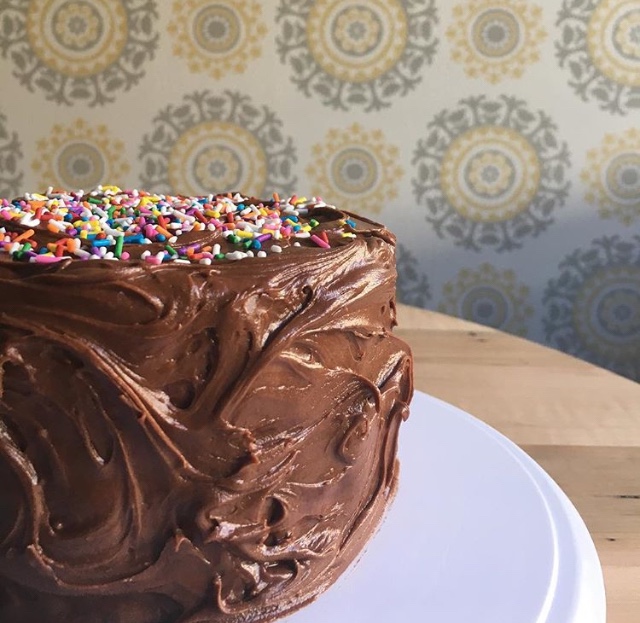
Both genealogy and baking can be challenging sometimes, but in both subjects, having the right recipe will help us achieve our goals. Happy researching!
1 Jennifer Wiebe, Jennealogie (https://maltsoda.wordpress.com/2019/07/12/sources-evidence-and-proof/: accessed 8 May 2020) “Sources, Evidence and Proof.”
2 Board for Certification of Genealogists (https://bcgcertification.org/: accessed 8 May 2020).
3 Wikipedia (https://en.m.wikipedia.org/wiki/Genealogical_Proof_Standard: accessed 8 May 2020) “Genealogical Proof Standard.”
4 Jennifer Wiebe, Jennealogie (https://maltsoda.wordpress.com/2019/05/24/cite-your-sources/: accessed 8 May 2020) “Cite Your Sources.”
5 Jennifer Wiebe, Jennealogie (https://maltsoda.wordpress.com/2019/10/17/derivative-vs-original-sources//: accessed 8 May 2020) “Derivative vs. Original Sources.”
6 Jennifer Wiebe, photograph of yellow cake with chocolate icing, October 2018, privately held by Jennifer Wiebe, Montreal, Quebec, 2018.


 Jennealogie
Leave a reply to maltsoda Cancel reply