
Clustering is all the rage! It all began with the Leeds method, a way to manually cluster your matches using the shared matches functions. It involves making a spreadsheet and colour coding your DNA matches until you have groups of matches. If you’re lucky, you end up with 4 distinct groupings, one for each grandparent. Highly suggest following the link and trying out this method for manually clustering your DNA matches.
Of course, it was not long before people realized that this could be done much more quickly by having a computer do it for you, and a few programs for automatic DNA match clustering came out. The one I’m talking about today is from Genetic Affairs. The first 200 credits are free and it costs 25 credits to run an autocluster. You can also have it send you notifications on new matches. You can run one autocluster a day during your free trial, and once your free trial is over (or you want to be able to run multiple clusters in a day) you can buy a subscription for a certain amount of credits per month depending on how much you pay (starting at 5$ a month). It works with DNA matches from Ancestry, 23&me and FTDNA.
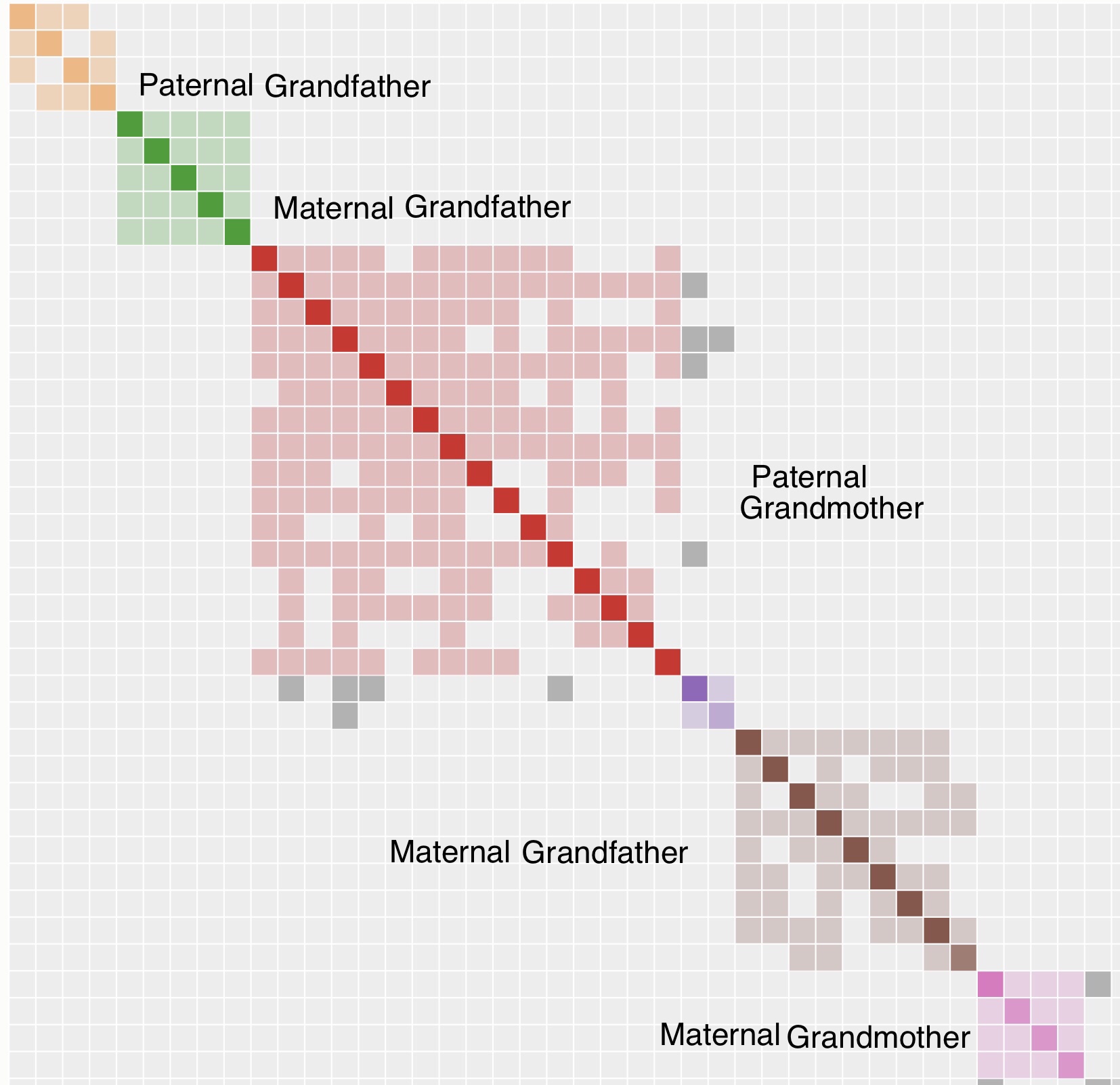
Here’s an autocluster I did for my mom. I had to fiddle around with the settings a bit to get the optimal chart. I set it based on a max number of centimorgans that excluded some of her close cousins once removed because they ended up being a part of multiple clusters. I also lowered it to catch more DNA matches. I don’t want to give specific numbers because each case is different, but if you look at your DNA matches and see who you want in the clusters (so you can identify the cluster) you’ll be able to check how many cMs that person has and figure out where the cutoff should be. You’ll also be able to see depending on how many DNA matches you have how much you want to lower the setting -make it too low and the chart becomes unreadable. It was frustrating to do only one chart a day so I did end up getting a subscription. I ended up with 5 distinct groupings (technically that little purple one should be part of the red). Each square represents a DNA match (the darker squares are where the person matches themselves). I cropped out all the names which would appear at the top and the side of the chart that identify these matches. You can see that there aren’t a lot of DNA matches on my mother’s paternal grandfather’s side, whereas her paternal grandmother’s side is more prolific. You’ll also notice that I have two separate clusters for her maternal grandfather. I have no idea who his father is, but I do know that in the green is a DNA match who is descended from my great-grandfather’s half-brother. I suspect then, that the brown cluster holds the answer to his paternity. Exciting! At the bottom of the chart (not shown) you get a list of the members in each cluster, hotlinked to the match summary on the original website. It also shows you any notes you have made on that match which is super helpful.
Here is an autocluster I did for my Dad. My dad’s heritage is endogamous, meaning that he comes from a heritage group that lived together and intermarried for many generations. If you’re from a community like this (think Jewish, Irish, French-Canadian) you can see it in your DNA results. For one, you will tend to have a lot of DNA matches, because everyone in that group is related to to almost everyone else. For two, the amount of centimorgans you share with them will be skewed. I have a match that should be a third cousin based on the amount of centimorgans, but is actually a 5th cousin in three different ways! When I was setting the chart settings here, I was much more conservative. I raised the minimum and lowered the maximum. And I still got something that is pretty much unreadable. While you can see some clusters in there, the grey dots mean that people in those clusters are matching people in other clusters. So if you are from an endogamous community, clustering is probably not going to work for you.

If you think my cluster is going to be a nice mix of mom and dad, you’d be wrong. As you can see, my father’s endogamy pretty much washes out my maternal DNA matches. I can’t adjust the setting because then I’d lose my maternal DNA matches. I’m just really thankful both my parents agreed to test so I can see the differences!

I hope this was informative and gives you an indication of whether or not clustering will be useful for you. I can see already that it was useful for me: I’m pretty excited to tackle the DNA matches in my mother’s brown cluster and see if I can figure out who my 2nd great grandfather was!

 Jennealogie
Leave a reply to I got my DNA tested, now what? | Jennealogie Cancel reply