
I have been thinking a lot about triangulation since MyHeritage upgraded their chromosome browser (you can read about that here). People have been posting about their experiences using it in some of the genealogy Facebook groups I’m a part of. The first thing I realized is that many people don’t understand triangulation (heck, I didn’t fully understand it myself until I wrote my first post on it). Like I did, many people think that as long as everyone shares segments on the same spot on the same chromosome, they have a triangulation. They forget that triangulation has two parts, and that the second part is that everyone in the triangulation group also all have to be related to each other. Conversely, they may think, I am related to both my cousins, they are related to each other, why don’t we triangulate? They have forgotten the first part, that each person in the triangulation group has to share a segment of DNA in the same spot on the same chromosome. Each cousin may have inherited different DNA segments from their common ancestor, and it’s possible that the common segment you share with cousin A, cousin B didn’t get, and vice versa.
Since I had finally figured out myself how to triangulate properly, I figured all I had to do was go back to my matches and make sure we were all triangulated properly and then I should be solving genealogical mysteries left, right and center. Sadly, this was not the case. Even using the short cut paid Tier 1 tools at Gedmatch, I have yet to find a single common ancestor. It was when I read this article, Triangulation is the icing, not the cake, my suspicions that triangulation is not necessarily what it’s cracked up to be were confirmed. Tl;dr: finding DNA matches who triangulate and are very distant is easy, finding DNA matches who triangulate and are very close is not.
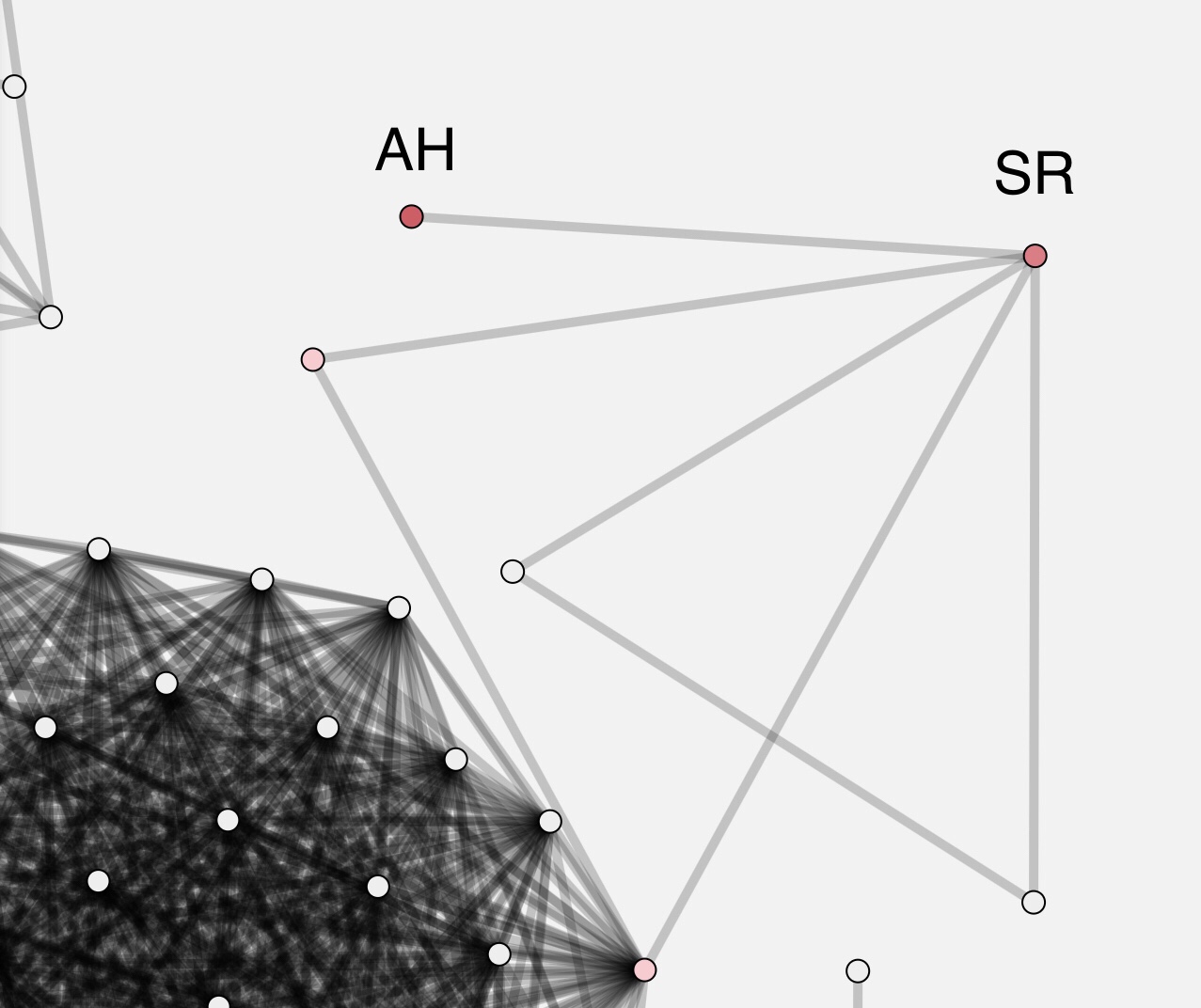
As I mentioned in my post Lost on a Deserted Island, I discovered a distant cousin via the website Lost Cousins. She has done her DNA at Ancestry, and we share DNA, so I asked if she would upload her results to Gedmatch so we could compare chromosomes. We share a lovely bit of DNA on chromosome 5, and we share it in common with my great-aunt, S.R. Since S.R. also has her DNA at Gedmatch, I was also able to compare the two of them. This cousin and my great-aunt share 5 good-sized segments of DNA on 5 different chromosomes. Wow. Now all I had to do was run triangulation again (not an easy feat since Rootsfinder users have been hogging the servers) and I would be rolling in DNA matches with the mystery of our common ancestor pretty much already solved.
They say a picture is worth a thousand words, so here is a picture of my findings. Here is my distant cousin, A.H., represented by one pink dot, and my great-aunt S.R., represented by another pink dot. The lines connect matches who are related to each other in the same way. Sad, isn’t it? Despite all the DNA in common, there are no other users on Gedmatch who share this DNA with us.
Furthermore, I have a triangulation group that I’ve been working on where most of the group is distant matches. I figured that since one of the matches was in the 3rd to 5th cousin category, and another of the matches was my great-aunt S.R., it should be pretty easy to figure out. While my tree goes back far enough, many of my matches’ trees do not, furthermore, even if they do and I see names and places in common I still do not know how our trees connect. When I turned to Gedmatch, my 3rd to 5th cousin became my 5th cousin, and one of my matches who was 4th to remote was found to be a 7th cousin. Not going to be solving this one anytime soon…or possibly ever.
While I’m disappointed that triangulation hasn’t turned out to be my meal ticket to solving genealogical mysteries, I know I still have a lot a lot to explore. And if a chromosome 5 match does turn up, I’ll be ready.


 Jennealogie
Leave a reply to maltsoda Cancel reply