
This post is going to be all about triangulation: what it is, why it’s important for genetic genealogy research and how to do it properly. Confession time: I have been doing triangulation all wrong. Come and learn from my mistakes!
Triangulation is like a three-legged stool that you need to sit on to do your genealogy research. If the legs of the stool are too close together, or if one of the legs of the stool is missing, then you’re going to fall off the stool and no research is possible. Triangulation needs to be done correctly in order to establish a sound foundation for your research.
So what is triangulation? If you guessed that it was something to do with a triangle, you are correct! Let’s say you have a DNA match. Hooray! How are you related? Maybe your trees don’t go back far enough to figure out the match. More data is needed. This data can come in the form of another match, if this match matches you and your match in the same way. You and your two matches are the three corners of the triangle. The question is, how do you figure out if you and your two matches are related to each other in the same way?
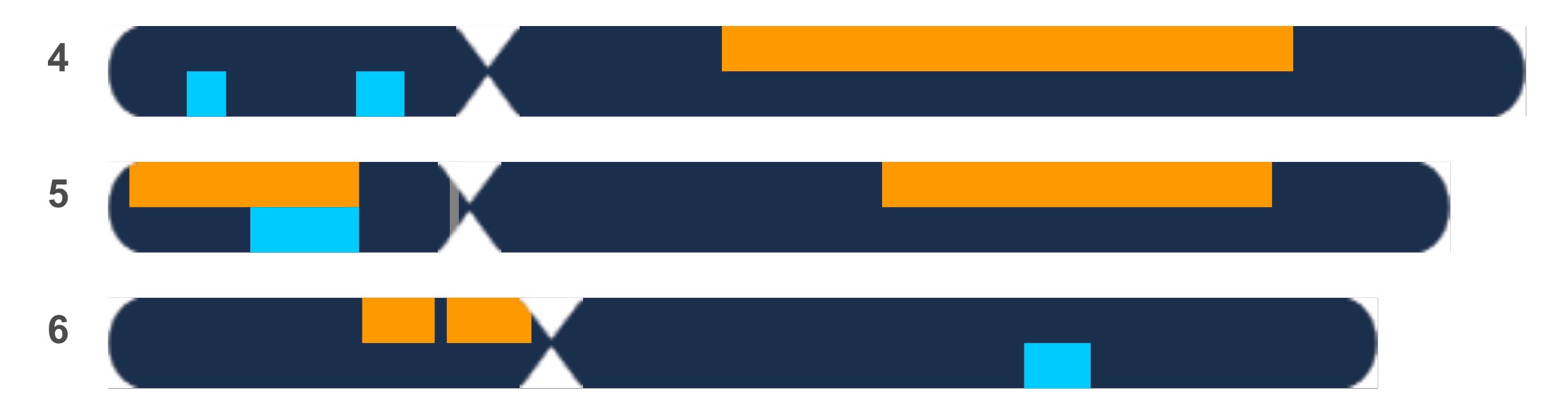
The first step requires a chromosome browser. Sorry Ancestry users, this is not for you. Please upload your raw DNA file to GEDmatch and try again. On FTDNA, you can click on your matches and hit the button for the chromosome browser. Here’s a lovely picture of a couple of my chromosomes. I’m navy blue, one of my matches, F.D., is light blue, and the other match, S.R., is orange. As you can see, we have a bit of overlap in a spot on chromosome 5! Success! However, this does not confirm the triangulation. This was my first mistake. You’ll notice that S.R., the person with the DNA marked in orange, shares quite a bit of DNA in common with me. She is my maternal great-aunt. F.D, the person in light blue, has a surname that is common on my Dad’s side of the family. My parents are not related. How are these two people related to each other and to me in the same way? (Answer: they’re not). You might not have an easy way to distinguish your paternal and maternal matches as I do, so it might take you much longer than it took me to realize that I have TWO chromosome fives, one from my dad and one from my mom. Although both people look like they match me in the same spot, in reality they are matching me separately on each of my chromosome fives.
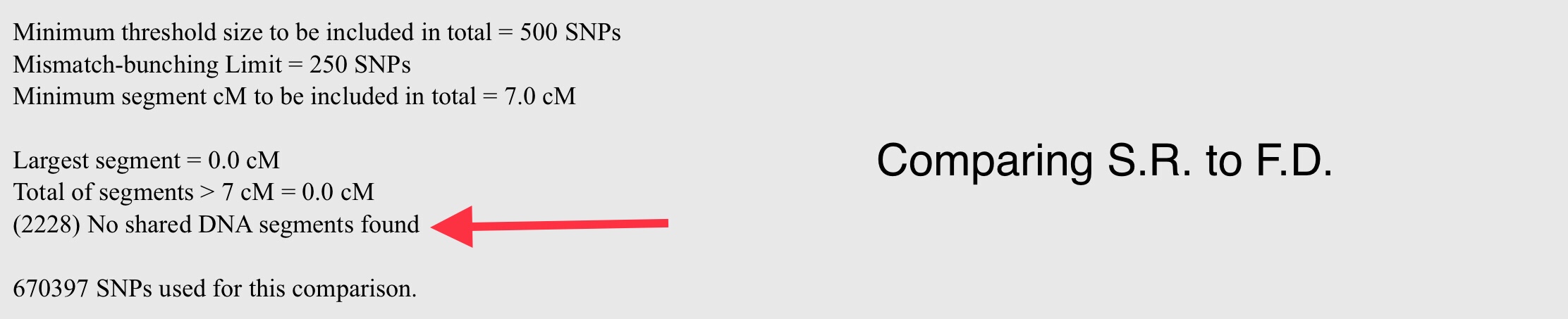
Luckily, FTDNA has a tool called a Matrix than can help you sort this out. Once you have found a match (or more than one match) that all match you and each other in the same spot on a chromosome using the chromosome browser, the second step is to use the Matrix tool. The Matrix will tell you if your two matches are related to each other. Now this doesn’t completely solve the problem, because they could still be related to each other and to you but in different ways, but it’s a start. If I had known about this tool when I discovered this match, I wouldn’t have wasted as much time on it as I did. You can find the Matrix tool on the myFTDNA menu under myDNA >family finder >Matrix. It’s a little annoying to use, since you have to scroll down and select your matches rather than search for them. The three little dots in the corner of the grey box called “matches” will pull up the list of your matches. Select the ones you want to compare, then click add. A nice box that compares your matches should pop up. Blue with a check? Your matches are related to each other. Blank? Your matches are not related to each other. Here’s what the comparison of S.R. to F.D. looks like.

As you can see, they are not related to each other, and so this is not a triangulation. This will not help me figure out how I am related to S.R. or to F.D., not will it tell me which of my ancestors gave me that segment of DNA on chromosome 5.
Here’s what the Matrix looks like when people are related. I chose known cousins of S.R., F.G. and W.M. Again, this still does not 100% confirm triangulation. It is still possible that F.G., W.M. and S.R. are related to each other in a different way than they are related to me. Since FTDNA does not give me the information about how they are related, all I’ve done is confirm that this is a possible triangulation.

Edit 9 March 2024: check out my updated post for a much simpler way to do triangulation
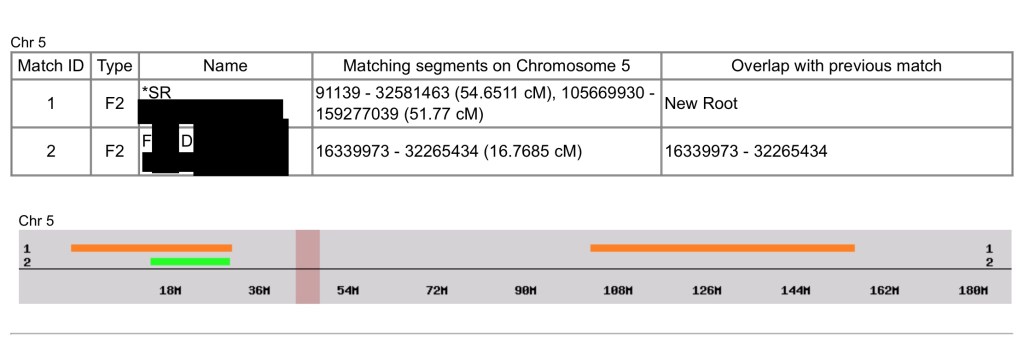
Let’s see how this works on Gedmatch. First, run a ‘one to many matches.’ Then click on the two matches you would like to triangulate with and hit submit. Then choose 2D or 3D chromosome view (personally I find the 2D one easier to look at).
Here’s S.R and F.D. On Gedmatch
Again, it looks like we have an ancestor in common. However, when I run a ‘one to one compare’ on both their kits, I get this:
Let’s run a triangulation between two of my matches, G.K. and P.B., on Gedmatch. I originally found these two matches on FTDNA, found that they both overlapped on Chromosome 3, and started pursuing them as if all three of us shared a common ancestor. They are lovely people and responded to my emails. But what if I was doing it wrong, and we don’t share a common ancestor at all? It’s like trying to connect the dots on two separate puzzles. Luckily, they are both also on Gedmatch.

Let’s run their kits in a ‘one to one compare’:
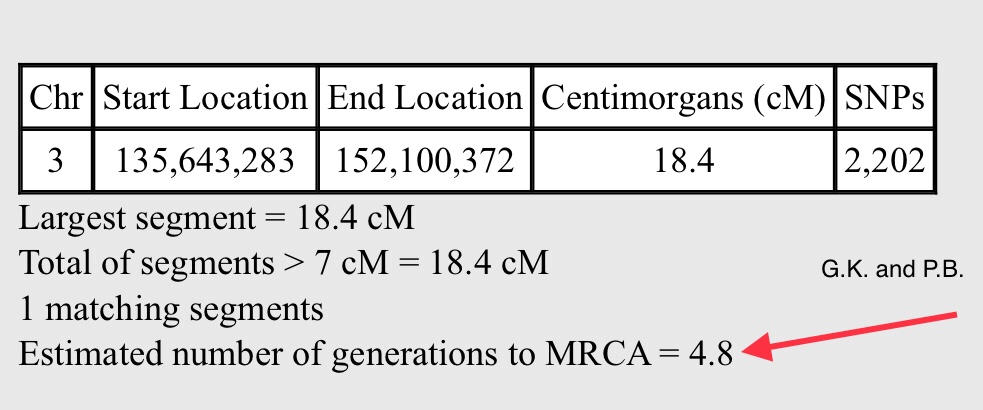
Since they have a MRCA (most recent common ancestor), they are related to each other. Are we all related in the same way? It’s clear that we’re all related on the same Chromosome, and we can compare start and end locations to make sure it’s in roughly the same spot. If you look at the first picture with G.K. and P.B., above the chromosome browser in the table, in the column “Matching segments on Chromosome 3” and in the second picture in the columns “Start Location” and “End Location” you can see that they both start at around 135,000,000 and end at roughly 152,000,000. Yay! A Triangle! If only it were just as easy to figure out who our common ancestor is…
Continue reading about triangulation in Triangulation part 2, in which one of the greats of the genealogy world answers my question about triangulation!


 Jennealogie
Leave a reply to I got my DNA tested, now what? | Jennealogie Cancel reply