
What is DNA? Rather, what do you need to know about DNA to make it useful for basic genealogy research?
We have 23 pairs of chromosomes, 22 pairs called autosomes and one pair of sex chromosomes. For most people their sex chromosomes are XX (for those assigned female at birth) or XY (for those assigned male). There are three types of DNA tests out there, the first being your “deep” ancestry and the second your autosomal ancestry. The third type is usually done along with the autosomal test; it is the DNA carried on your X chromosome. “Deep” Ancestry traces DNA going back on either the maternal or paternal line thousands of years. Ancestry on the maternal line (found in mitochondrial DNA) is carried by people of all sexes, whereas the paternal Y-DNA is only carried by those with a Y chromosome. The nice thing about deep ancestry testing is that it automatically sorts out for you which DNA comes from your mom and which comes from your dad. The downside is that it is usually more expensive than the autosomal tests. Most DNA testing companies only do autosomal testing, among those that offer both types of tests, the autosomal test is usually referred to as the “family finder.” Autosomal testing looks at all your chromosomes, half of which you inherited from your mom, the other half from your dad. Many people believe that only men can get DNA tests, or that DNA tests done by women will not show paternal ancestry. This is only true of Y-DNA tests. Autosomal DNA tests will show you both maternal and paternal DNA regardless of sex. The DNA on your chromosomes is measured in units called centimorgans (cMs).
Imagine if two books got married and had a baby book. The baby book now has “it was the best of times, it was the worst of times” and “to be, or not to be, that is the question.” As the baby book grows up and has baby books of its own, and so on, eventually all the books that have these phrases can trace themselves back to the original books. They know that they are related both to the original book and to each other. However, since DNA is pretty random, a bunch of books could be descended from these two books and not have even one of these phrases. Perhaps a book only has part of these phrases. The further down the line you get, the less likely it is that a person has the original complete phrase. The more of the original complete phrase you share with someone, the more closely you are related to them. In the genetic genealogy world, we call this Identical By Descent (IBD).
It’s also possible for someone to have one of these phrases, or part of it, but that the phrase came from a completely different book, or from the jumbling together of many different books, none of which are related to the original book. Remember how a million monkeys on a million typewriters will eventually produce the work of Shakespeare? In the genetic genealogy world, these are called Identical By Chance (IBC), or Identical by State (IBS). Obviously, the more of the phrase you share with someone, the greater the likelihood that it isn’t chance. Sharing the words “and” and “the” is likely to be by chance. Here’s a really good link that will show you the likelihood that the DNA segment you share with someone is the same because you’re related or by chance based on how long the segment is. Here’s another interesting link that will show you how much DNA you’ll likely share with someone based on your relationship to them, from parents or siblings all the way up until distant cousins.
This article (also a good read for beginners) has a lot of great pictures of how inheritance can work. Someone posted this picture to Facebook that is a really cute way of showing inheritance:
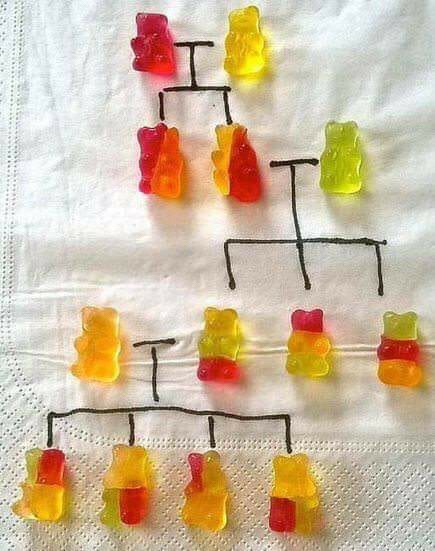
The companies use the measurement of how much DNA you share with someone to make their determination of how you are related to them, but it’s not an exact science. It could happen, for instance, that I inherited 50% of my DNA from my dad, and 50% from my mom, and that one of my siblings inherited the other 50% from each of them. We now both share 50% of our DNA with our parents, but none with each other. It’s unlikely, but it could happen. Another problem I’ve noticed is with very endogamous lines. I often get 2nd cousin matches where I am able to trace the common ancestor and it is way further back than 2 generations. We both just happen to share a lot of DNA with each other, because our ancestors shared a lot of DNA. When you live in a small community, sometimes there aren’t any new books in the library to take out. I’ve also had a cousin who appeared to be very distant at 4-6 generations back and turned out to be just 3. Of course, I knew this particular match was my half-cousin, so of course the match was going to appear twice as far back than it really was. Generally though, I’ve found that that matches are usually further back than they appear.
Some companies offer a chromosome browser to allow you to further analyze their DNA results. I love this, except that we have 23 pairs of chromosomes, and the chromosome browser (at least the one on FTDNA) doesn’t show you the pair, it just shows the 23 chromosomes. So while for the most part it is accurate to say that whoever matches me on a particular spot on a particular chromosome is also related to another person who matches me in the same spot, this isn’t always the case. See my post on triangulation to hear the story of how I figured out that I have two of each chromosome.
So what’s the take from all this?
If you’re not interested in your deep roots, going back thousands of years, just take the autosomal test
Just because you and someone else have DNA in common, doesn’t mean you are related
Generally speaking, the more DNA you share with someone, the more likely you are to be related and the closer you are related to them
Generally speaking, people who share a segment in the same spot on the same chromosome are all related to each other, if you know that they all come from the same side of your family
Read on for DNA in a Nutshell, part 2


 Jennealogie

Leave a reply to Don’t touch the settings! | Jenealogy Cancel reply