
maltsoda
-
AutoSegment Split
There’s nothing that makes you feel older than when you start talking about how you used to do things “back in the day.” The problem with genetic genealogy is that back in the day isn’t really that far back. Since the advent of consumer DNA testing 25 years ago, great strides have been made to…
-
AutoKinship
AutoKinship is a Tier 1 tool at GEDmatch. Unlike Autotree (1), it does not require GEDcoms to be useful. AutoKinship creates possible family trees based on the amounts of DNA that the matches share with each other, which means that it doesn’t require any of those matches to have trees associated with their accounts. Like…
-
AutoTree at GEDmatch
AutoTree isn’t actually a standalone tool, so technically, this post is the sequel to my AutoCluster post (1). AutoTree searches the GEDcoms of your matches to see if it can find an MRCA for each cluster. Check off the AutoTree box to get AutoTree results when using the AutoCluster tool. Once you get your results,…
-
AutoSegment at GEDmatch
Now that I’ve explained the clustering (1)and triangulation (2)tools at GEDmatch, the scene is set to introduce a tool that I think of as the baby of these two tools. AutoSegment is a Tier 1 tool which you can find in the sidebar or dropdown menu. You enter a kit number and the number of…
-
Clustering at GEDmatch
A new tool recently came out at GEDmatch, and I wanted write a blog post about it so I could understand it better. I realized, however, that I had never written about GEDmatch’s clustering tool, which is useful for understanding how this new tool works. I’ve talked about clustering (1) before, when it was a…
-
Privacy and the Genealogist
Genealogists need to be aware of applicable privacy legislation, especially as more and more privacy laws come into effect. In Canada, one such legislation is a federal law called the Personal Information Protection and Electronic Documents Act (PIPEDA). (1) PIPEDA applies to private-sector organizations as well as federally-regulated businesses. Although Alberta, British-Columbia, and Quebec have…
-
Ancestral Trees at DNA Painter
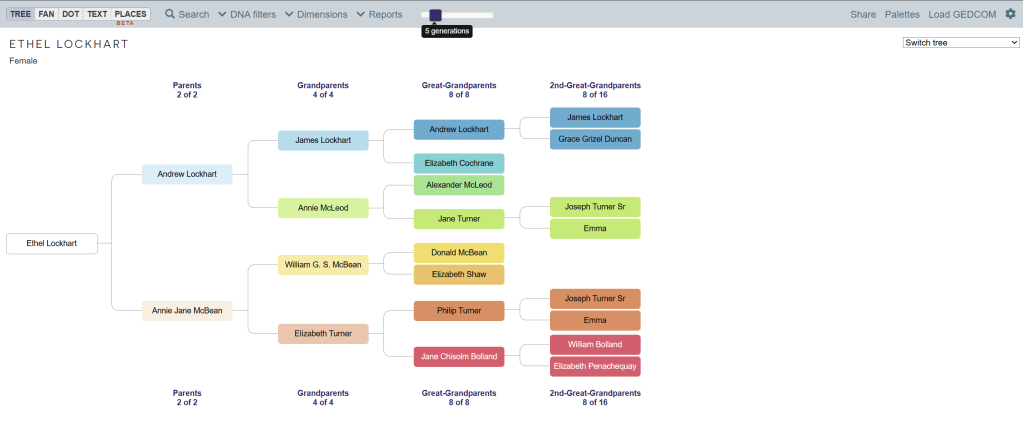
I’m sure most genealogists are familiar with the DNA Painter website.1 Whether it’s to use WATO to figure out an unknown parent or to do some Chromosome Mapping, this site is instrumental for anyone working with their DNA.2 Late last year I learned about another tool on the site called Ancestral Trees:3 Not only can…
-
What is a genetic network?
A genetic network is simply a group of DNA matches, and is the basis for all genetic genealogy work. These networks can be explored using DNA test results. Just two people who share DNA make up a network, although it is much more useful when it has many people. There are many ways to find…
-
What is a Most Recent Common Ancestor?
In my post What is a Cousin? (1) I talked about how cousins are related to each other, so people could understand what “removed” means in terms of genealogy. I even linked to a handy Cousin Calculator (2) so that anyone trying to figure out their relationship to their cousin could easily figure it out.…
-

Triangulation, Part 5
I didn’t think there was anymore to say about triangulation, and then I was working on some presentations on various Gedmatch tools and noticed that there is now a triangulation tool. This tool kind of makes my original post (1) moot, but I’ll keep it up there because it’s a good explanation of what triangulation…
 Jennealogie