

I didn’t think there was anymore to say about triangulation, and then I was working on some presentations on various Gedmatch tools and noticed that there is now a triangulation tool. This tool kind of makes my original post (1) moot, but I’ll keep it up there because it’s a good explanation of what triangulation is and why it’s useful. You can skip the explanation of how to do triangulation and head back here once you understand the basics.
The triangulation tool is available for free but if you’re really interested in getting good use out of it, you’ll see why the Tier 1 version is worth paying for.

You’ll need to use the One-To-Many Original Version, since that’s the one you can use the select button with. However, unlike the Tier 1 One-To-Many tool, you don’t have a select all button, so you have to manually select all the kits you want to be included. Then hit the “Visualization Options” button.
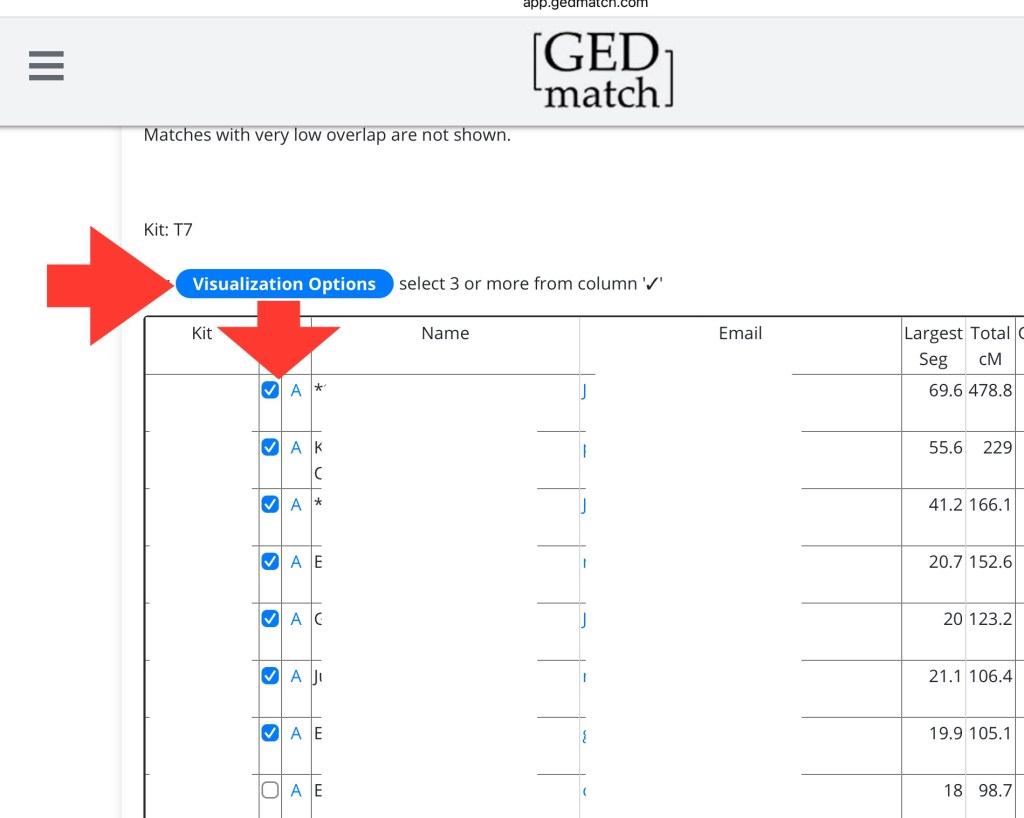
You’ll be taken to a page where you can add or edit kit numbers, so hit “Visualization Options” again.

Here you can see an example of the triangulation. The red square represents an area where several kits triangulate with me, and the arrows show where I triangulate with two other kits.

As I mentioned, the Tier 1 triangulation tool is much simpler.

All you have to do is put in your kit number and adjust the settings.
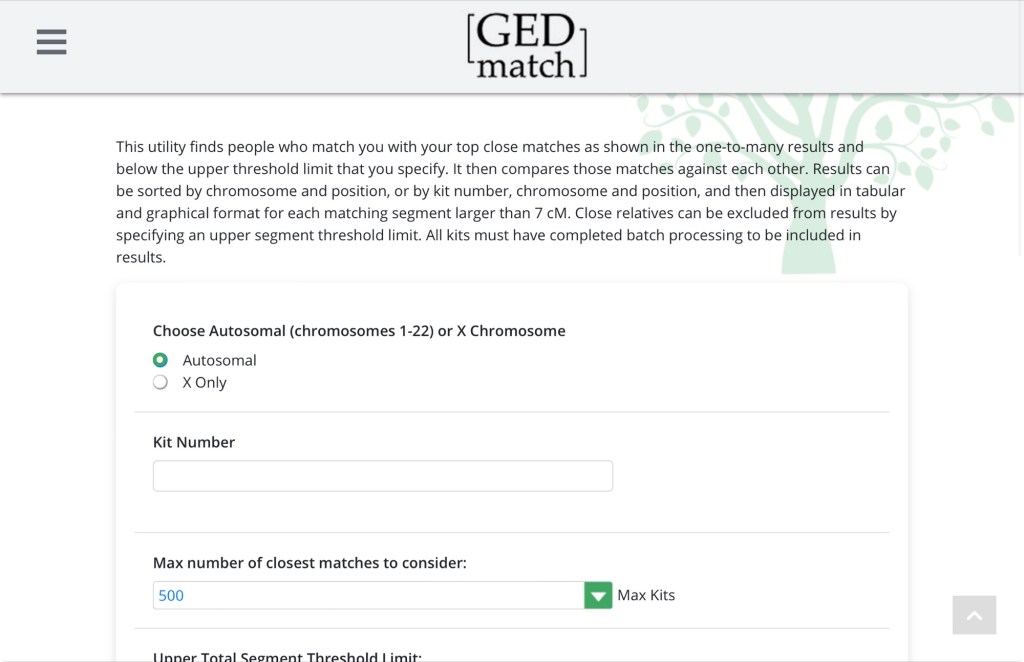
Note that with the free One-To-Many tool, you can see up to 3000 matches. So if you have the patience to click that many times, you could see triangulation groups for 3000 of your closest matches. With the Tier 1 triangulation tool, however, one click will get you triangulation groups for your closest 5000 matches. That’s worth the price for me!
It’s fun to play around with this tool. I noticed I have a lot of triangulation groups, which isn’t surprising given that half my DNA comes from an endogamous population. When I ran my non-endogamous great-aunt’s triangulation, I was able to spot a pile-up region. (8) It really stood out since most of her triangulation groups were not very large, and then on one chromosome a group filled the entire page and then some.
What questions do you have about triangulation? Let me know in the comments!
1.Jennifer Wiebe, “Triangulation,” Jennealogie, 24 February 2018 (https://jennealogie.com/2018/02/24/triangulation/ : accessed 9 March August 2024).
2. Jennifer Wiebe, digital photo, One-To-Many Original Version, March 2024, author’s files.
3. Jennifer Wiebe, digital photo, Select kits, March 2024, author’s files.
4. Jennifer Wiebe, digital photo, Multi Kit Analysis, March 2024, author’s files.
5. Jennifer Wiebe, digital photo, Triangulation Groups, March 2024, author’s files.
6. Jennifer Wiebe, digital photo, Tier 1, March 2024, author’s files.
7. Jennifer Wiebe, digital photo, Tier 1 triangulation, March 2024, author’s files.
8. Jennifer Wiebe, “Triangulation, Part 4: Pileups,” Jennealogie, 19 March 2018 (https://jennealogie.com/2018/03/19/triangulation-part-4-pileups/ : accessed 9 March August 2024).

 Jennealogie
Leave a comment