
Remember Mad Libs? Teachers liked them because they were a fun way to review the parts of speech, and kids liked them because they could try to be as vulgar as possible and make their friends laugh.
The (noun) went to (place). The (noun) was (adjective).
Citations are a lot like Mad Libs, just not as much fun. However, using templates instead of starting a citation from scratch can make a big difference in simplifying the process of writing citations.
Many people know of the citation bible, Evidence Explained. Maybe you bought it because you heard it was essential for serious genealogists, or it was on your course list. However, if you don’t know how to use it, it’s only useful as a doorstop. So let’s look at a template from Evidence Explained and show how you can replace the information from the template with the information from your source.
Chapter 6 is all about census records, and they are the easiest to start with as far as templates go because every single citation for a census will be identical in format. Let’s look at the 1880 census on page 279. I don’t know of anyone looking at microfilms anymore, nowadays we are going to be looking at them digitally, so we will have to add in the digital information from page 280.
Here’s the citation:
St. Louis City, Missouri, 1880 United States Census, population schedule, FamilySearch (https://.familysearch.org/pal:/MM9.1.1/M6F6-T8C : accessed 1 April 2015), enumeration district (ED) 1, page 2C (stamped), page 3 (penned), dwelling 16, family 17, Nick Metzen; citing NARA microfilm publication T9, roll 717.
Note the use of italics, and note the two layers separated by a semi-colon.
Now, I’m going to copy the same citation and highlight parts of it. I will show you how I will replace all those parts, and where to find the information to replace those parts.
St. Louis City, Missouri, 1880 United States Census, population schedule, FamilySearch (https://.familysearch.org/pal:/MM9.1.1/M6F6-T8C : accessed 1 April 2015), enumeration district (ED) 1, page 2C (stamped), page 3 (penned), dwelling 16, family 17, Nick Metzen; citing NARA microfilm publication T9, roll 717.
The first thing we want to replace is the place where the person lives, in Nick’s case, he’s in St. Louis City, Missouri. Then we want to replace the URL. Sometimes there’s lots of junk after the URL so we can delete it all and see if it still gives us the same page. On FamilySearch I’ve noticed if I erase everything after the “?”, it puts some of it back and that’s what I use for my URL. We could even use waypoints! Here I will stick to a URL. After that is your access date, which is the date you are viewing it. We have spots for the enumeration district, the page (sometimes there are different numbers written or stamped on the page; I scroll back and forth to see if they correspond to page numbers), followed by the dwelling and family numbers, and then the person that we are looking at. We can also say “Nick Metzen household,” if we are looking at everyone in the household and not just one specific person. Finally the source of the source, which is the name of the microfilm publication, followed by the roll number.
I will note here that the part of the citation that says “population schedule” is not always a given, because there are other schedules, such as a farm schedule. But 99% of the time we are looking at where people were at a particular place in time, and so most likely when you’re looking at a census record you’re looking at the population schedule.
I found another 1880 census record, so let’s make a citation with it.
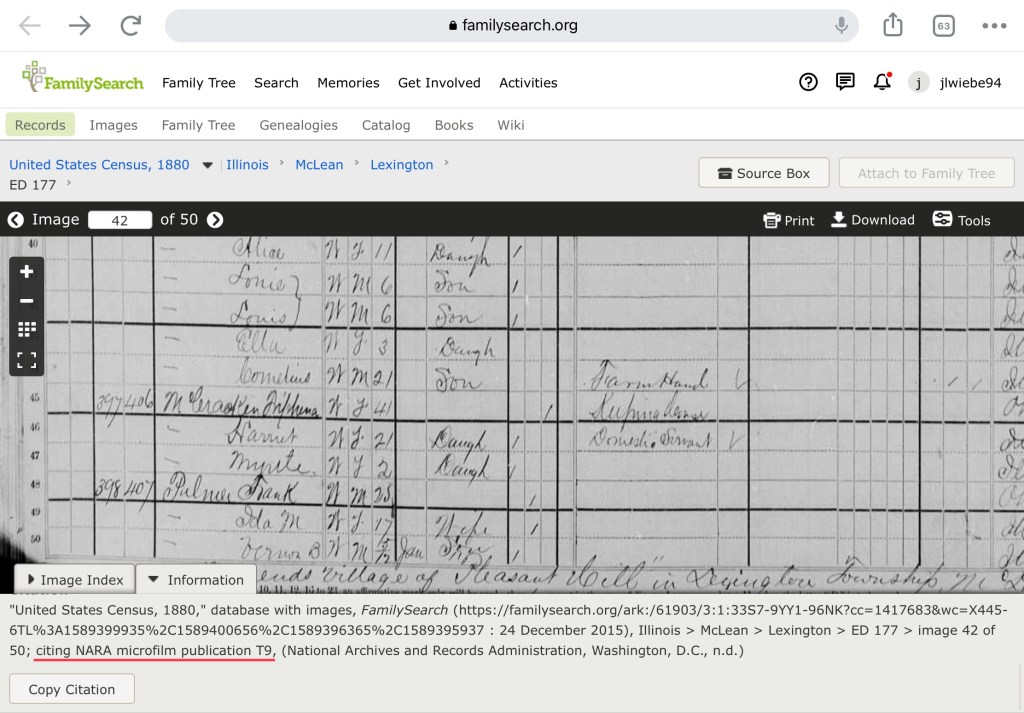
Village of Pleasant Hill, McLean County, Illinois, 1880 United States Census, population schedule, FamilySearch (https://www.familysearch.org/ark:/61903/3:1:33S7-9YY1-96NK?i=41 : accessed 20 July, 2022), enumeration district (ED) 177, page D (stamped), page 42 (penned), dwelling 397, family 406, Triphena McCracken household; citing NARA microfilm publication T9.
Let’s look at the source so you can see where I got my information from. First, the stuff from the top of the page:

Underlined in red is the place that makes up the first part of the citation. Underlined in blue is the enumeration district. Circled in yellow is the page numbers, stamped and penned. Let’s scroll down the page to see more information:

Circled in blue, the dwelling and family numbers, underlined in red, the person of interest’s name. Where do we find the “source of the source” info? If you click on the information and scroll a bit, you’ll get FamilySearch’s citation, which will include it. This particular one did not include a roll number, so I left it out:
I hope you can see how useful a template is. Once you have the template, instead of having to think through each element of a citation, you just replace the different elements with information from your source. Evidence Explained is just a big book of templates. Now that you know that, it will be more useful to you than as a doorstop!

 Jennealogie
Leave a comment