
The What Are The Odds (WATO) (1) tool is an extension of the SharedcM (2) tool I talked about in my post Centimorgans and Segments (3). You need to have a grasp of the concept of centimorgans and the relationships that are possible based on the amount of shared centimorgans to understand why WATO is useful.
The SharedcM chart is useful when you have a singular unknown DNA match. You know that they will fit into your family tree somewhere, as as represented by this blue circle. The bigger the match is, the smaller the circle will be, because the closer a match is, the more it narrows down where they will fit in your family tree. This still leaves a lot of possibilities, so finding a way to narrow down the blue circle even more would be helpful.

When you have two DNA matches who share the same family tree, you are able to narrow down the blue circle to where it overlaps with the red circle, as represented in this picture. The WATO tool allows you to calculate possible relationships that take into account the probabilities from the shared centimorgans for each DNA match, which will eliminate some of the probabilities of each. Helpful! However, you still need to know how at least two of the matches fit together, either you and one of the DNA matches or the two DNA matches. Further, it won’t work if there is more than one connection between the you and the matches or between the two matches.

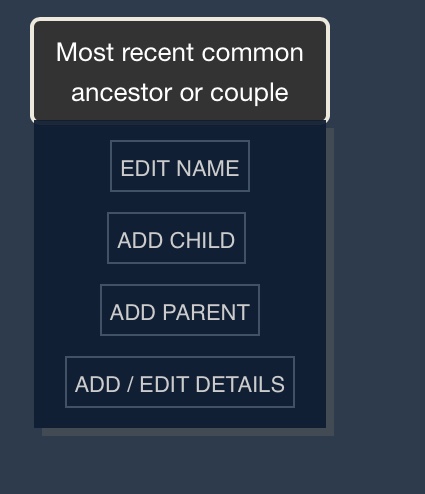
So let’s take a look at how the tool works. You will want to sign up for at least a free account, so you can save your charts. I’m just going to talk about building from scratch, but you can also import a Gedcom, although it gets a little unwieldy the bigger your tree is. The picture below represents what you see when you start a WATO. You’ll want to start with the ancestral couple that the DNA matches have in common.

You can add lots of details when you click on it, but for now we’ll just start with a name, and add a few children.

Keep repeating this process until you’ve added your DNA matches to the tree. In this made up tree, I have two DNA matches, Mary Smith and Jessica Johnson. I know that their most recent common ancestor (MRCA) is John Smith. I added their other child William Smith although I do not have any DNA matches that descend from him.

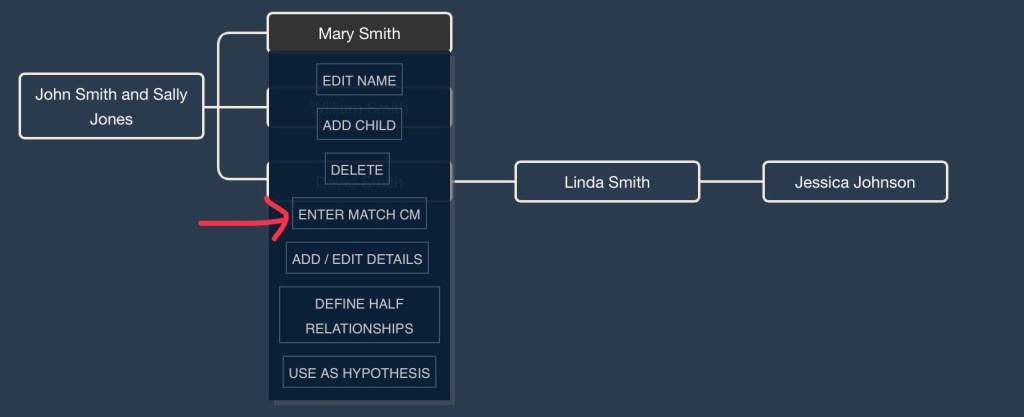
One of the options when you click to add details is “enter match cM.” I’m going to add the amount of cM the unknown DNA shares with each of their two matches.

In this scenario, I am trying to figure out how some unknown DNA fits into this family tree. The unknown DNA is the hypothesis. I can manually add hypotheses to the tree or I can use the suggest hypothesis button. Let’s do a manual one first. Is it possible that the DNA belongs to a child of Mary Smith? I will click on Mary Smith to add a child and then click on the child to add a hypothesis.


When the score is red/zero, this means that the hypothesis is not possible. The DNA definitely does not belong to a child of Mary Smith. Perhaps it could belong to her grandchild?

The score is green, which means it is possible. The score is 1, because it’s the only hypothesis we have, but there are likely other hypotheses that could be possible, so let’s check out the suggest hypotheses button. When I click it, I get an error message.

I need to go back and add details! The unknown DNA needs an approximate birth year. It will also help if you enter sex and at least birth years for all the people in the tree. Naming the target and putting a research question isn’t necessary, but if you have a lot of trees it can get confusing if they all have the same default name. Once all the necessary info is added, let’s try it again.
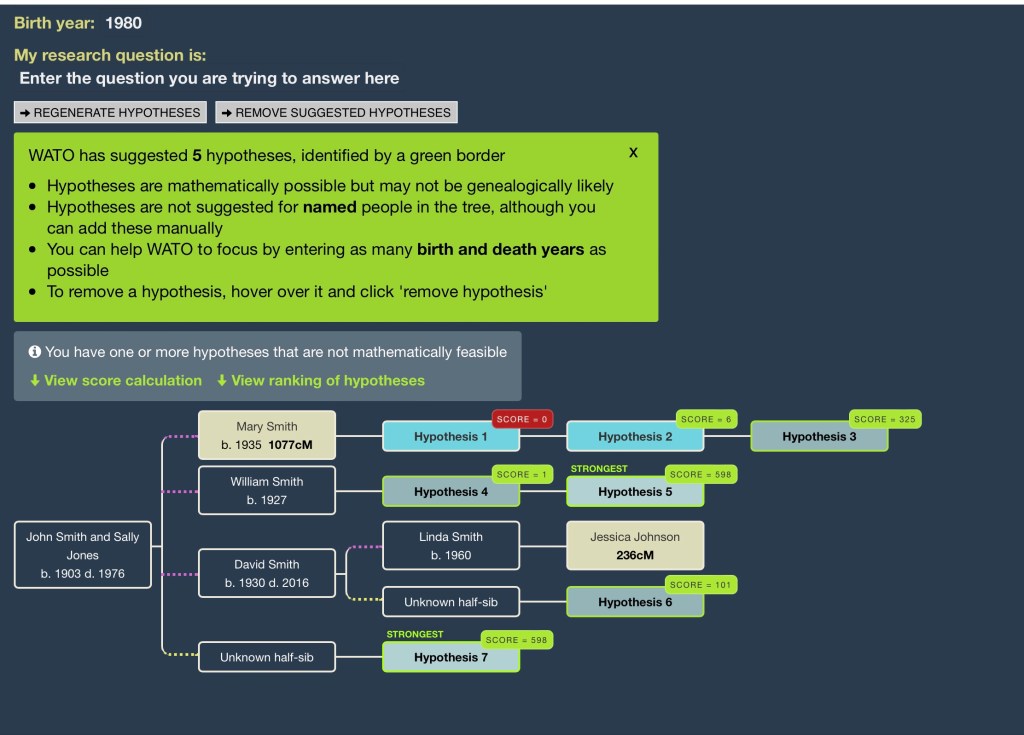
Before we talk about these hypotheses, I want to point out the yellow and purple dotted lines that connect the children of John Smith to their parents. David Smith’s children also have those dotted lines. Both the yellow lines connect to an “unknown half-sib.” You can create these half-sibling relationships yourself when you click on somebody with siblings (see the picture of adding details to Mary Smith above -click on “define half relationships”). The purple lines are half-siblings to the yellow line, but full sibling to each other.
As you can see, the child of of an unknown half-sibling has one of the highest odds. While I guess it’s possible that either Sally Jones or John Smith had an unknown child who would be a half-sibling, it’s a bit of a zebra hypothesis, more than a horse hypothesis. Remember, when you hear hoofbeats, think horses, not zebras. The AI is not doing thinking, it’s doing calculating, so we have to do the thinking. For example, look at hypothesis 3. If I know for a fact that the unknown DNA belonged to someone born in 1980, what ages were the descendants of Mary Smith when they had their children? If Mary was 20 years old when she had her child (currently marked as hypothesis 1), that child would have been born in 1955. If that child was 20 years old when she had her child (currently marked as hypothesis 2), that child would have been born in 1975. If the unknown DNA (hypothesis 3) was born in 1980, the math does not add up. The AI said, of course it’s entirely possible that this entire line had their children as young teenagers, and while this does sometimes happen, I’m going to mark this down as a zebra hypothesis.
The other highest hypothesis is for a grandchild of William Smith. While a child of William Smith is a possibility, the grandchild is more likely. However, we still can’t rule out the possibility that the DNA belongs to a child of William Smith. I know William has 5 children, so let’s add them to the tree. I’m also going to add another DNA match in so we can see how it shifts the hypotheses. I added the match in and hit “regenerate hypotheses.”

With the addition of William Smith’s son Anthony, you can see that more of the hypotheses were ruled out. Another half-sibling was added, but even then, the most likely scenario is that it is a grandchild of William Smith, through any of his children but Anthony.
We could also make another WATO for the wife of William Smith. If the unknown DNA belongs to one of his grandchildren, then it’s possible there are other DNA matches that connect to his wife’s tree. If I knew I was looking for the unknown DNA’s mother, Anne King would a prime candidate. If I was looking for the father, Cameron, James or Andrew are all equally likely. It would require DNA tests from either them or their children to confirm which one is the father. If I had reason to believe the parents of the unknown DNA were married, we could also look at each of the spouses of William Smith’s children to see if there are any DNA connections to their trees.
Two important things to remember about the scores: one, the score is relative to the other scores, so a higher score does not mean anything on its own, it is telling you how much better it is compared to the other hypotheses. Two, in order for one hypothesis to be significant, its score has to be at least three times as likely as the other one. While in this scenario we can pretty much ignore the hypothesis with a score of one, if we had another hypothesis with a score of 400, it would be worth considering as much the other ones at 598.
You can see how having close matches can really narrow things down, and how having a smaller tree is really helpful. Imagine how much more difficult it would be if John and Sally Smith had 10 children! WATO is a tool like any other — it doesn’t give you the answers, but it can help you find the answer by pointing you in a direction. Like many tools, it is much better for excluding rather than identifying. Despite its limitations, it is an invaluable tool, and definitely something someone who wants to work with unknown DNA needs to know how to use. I highly recommend practicing using it even if you don’t have unknown DNA to figure out — use your own DNA matches, and see what possibilities exist for your place in your own family tree!
1) Jonny Perl, DNA Painter (https://dnapainter.com/probability : accessed 17 April 2022).
2) Jonny Perl, DNA Painter (https://dnapainter.com/tools/sharedcmv4 : accessed 17 April 2022).
3) Jennifer Wiebe, “Centimorgans and Segments,” Jennealogie (https://maltsoda.wordpress.com/2019/08/22/centimorgans-and-segments/ : accessed 5 August 2021).
4) Jennifer Wiebe, digital photo, One DNA match, April 2022, author’s files.
5) Jennifer Wiebe, digital photo, Two overlapping DNA matches, April 2022, author’s files.
6) Jennifer Wiebe, digital photo, Beginning a WATO, April 2022, author’s files.
7) Jennifer Wiebe, digital photo, Adding details to a person in WATO, April 2022, author’s files.
8) Jennifer Wiebe, digital photo, WATO with names and children added, April 2022, author’s files.
9) Jennifer Wiebe, digital photo, Smith family tree, April 2022, author’s files.
10) Jennifer Wiebe, digital photo, Enter match cM, April 2022, author’s files.
11) Jennifer Wiebe, digital photo, Tree with match cM entered, April 2022, author’s files.
12) Jennifer Wiebe, digital photo, Adding a hypothesis, April 2022, author’s files.
13) Jennifer Wiebe, digital photo, Hypothesis for child of Mary Smith, April 2022, author’s files.
14) Jennifer Wiebe, digital photo, Hypothesis for grandchild of Mary Smith, April 2022, author’s files.
15) Jennifer Wiebe, digital photo, Suggest hypotheses error, April 2022, author’s files.
16) Jennifer Wiebe, digital photo, Suggested hypotheses, April 2022, author’s files.
17) Jennifer Wiebe, digital photo, New match added, April 2022, author’s files.

 Jennealogie
Leave a comment