
Chromosome painting is one of those things that looks super confusing until you do it and realize it’s really not so complicated. And then you get addicted to it. I talked a little bit about chromosome painting in my post Painting Your Matches with Rootsfinder (1) but I’ve apparently never talked about Jonny Perl’s DNA Painter (2) tool.
I’m not going to talk about how to do it here since Roberta Estes already wrote a fabulous post (3) explaining all about how it works, but I did want to show why I think it’s neat.
One thing I also think is worth mentioning is that both 23&me (4) and FTDNA (5) have chromosome ethnicity painting, and you can also capture this data and bring it into DNA painter.
Here’s a snapshot of my ethnicity-painted X from 23&me. I’m kind of lucky in the sense that my Dad comes from an endogamous population and is fairly easy to identify. My mom’s DNA comes from a few different regions but those differences also make her parts easy to identify. Even though they haven’t tested at 23&me yet, I was able to figure out which X came from which parent. The yellow is indigenous, so I know it came from my mom’s dad, more specifically from his mother, whose ancestors worked for the Hudson’s Bay Company. The turquoise is Eastern European, which is from my half-Polish maternal grandmother, and the light blue is “broadly northwestern European.” This could have come from either maternal grandparent, but since I match with my grandfather’s cousin in that spot I was able to figure out that it came from my grandfather.

Here’s a picture of the matches I have painted on my maternal X using the DNA painter tool. I knew that the indigenous chunk at the beginning came from my grandfather’s mother, but I was curious to see how far back I could attribute this segment. My great-grandmother could have got this DNA from either of her parents. By looking at the matches I have painted, it’s possible to figure out which parent she got it from. M, J and S are related to both my 2x great-grandparents, so that doesn’t narrow it down, but G is only related through my 2x great-grandfather’s line. I discovered G on Gedmatch when sorting my match list by amount of shared X DNA. G is also on Ancestry, and has a tree there, so that’s how I was able to figure out how we connect. Our common ancestors are my 4x great-grandparents! And since 23&me told me that this segment represents indigenous DNA, that means it came from my Métis 4G-grandmother, not her Scottish husband. Neat! I really only have proof that the segment I share with G goes back to her, not the entire segment identified as indigenous, but I’ll take it.
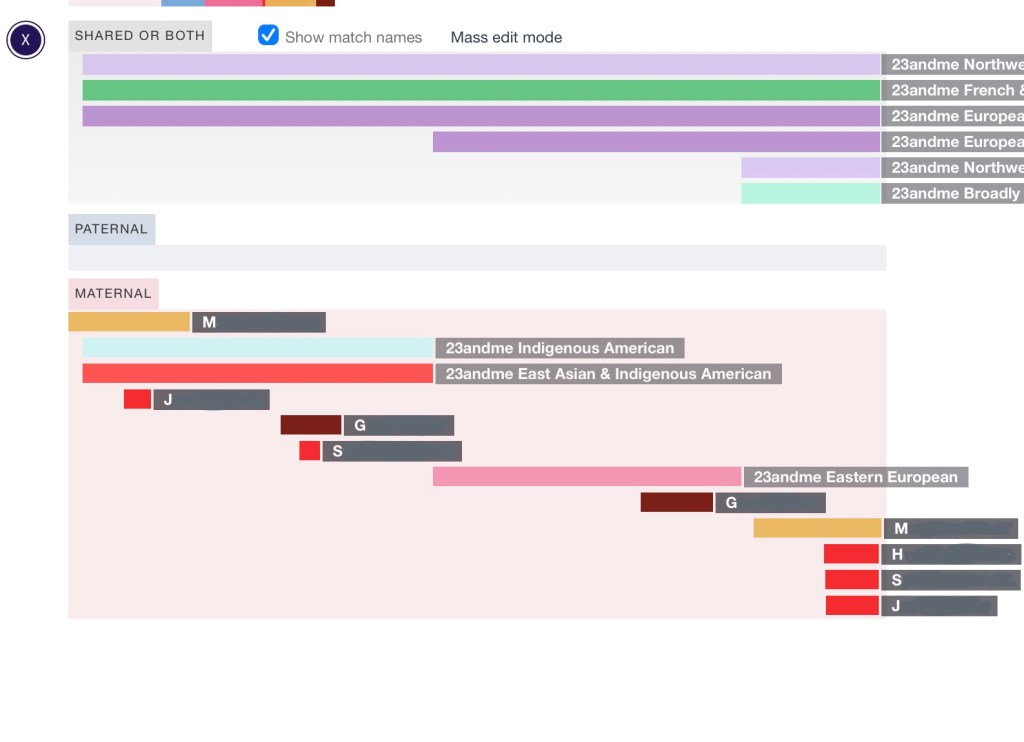
Chromosome painting is not just for figuring out which DNA segments came from what ancestor, it’s also helpful to know how you are related to unknown matches. For example, if I hadn’t found G’s tree on Ancestry I would have needed to email him. By placing G in my painting, I can see he overlaps with S. I know how I’m related to S, so therefore I know how I’m related to G. As I wrote in Crafting the perfect letter to DNA matches (8), the more specific you are when you email matches, the more likely you are to get a response. Of course, knowing that G and S overlap means that I need to know that G is on my maternal side. G and S overlapping means nothing if I don’t know what side he’s on.
So far I have 30% of my chromosomes painted, but about 50% of my maternal chromosomes. I would love to be able to put together the DNA of my ancestors by painting more. To do that, I will have to get my relatives who have tested only at Ancestry to do a free transfer of their DNA to either FTDNA or Gedmatch (while I like MyHeritage, the fact that they don’t give segment info for the X chromosome is very disappointing). If you’re related to me, have tested at Ancestry and want to help me with this, follow the instructions here (9) to do that! If you’ve tested at 23&me, we need to “connect” on 23&me so I can see chromosome segment data. Looking forward to comparing our segments!
1) Jennifer Wiebe, “Painting Your Matches with Rootsfinder,” Jennealogie (https://maltsoda.wordpress.com/2018/02/27/painting-your-matches-with-rootsfinder/ : accessed 14 April 2022).
2) Jonny Perl, DNA Painter (https://dnapainter.com/https://dnapainter.com/ : accessed 14 April 2022).
3) Roberta Estes, “DNA Painter – Chromosome Sudoku for Genetic Genealogy Addicts,” DNAeXplained (https://dna-explained.com/2018/03/28/dna-painter-chromosome-sudoku-for-genetic-genealogy-addicts/ : accessed 14 April 2022).
4) Sarah Laskey, “Meet Your Chromosome Painting,” 23&me (https://blog.23andme.com/ancestry-reports/meet-your-chromosome-painting/ : accessed 14 April 2022).
5) “New Feature: myOrigins Chromosome Painter for Family Finder,” FTDNA (https://blog.familytreedna.com/new-feature-myorigins-chromosome-painter-for-family-finder : accessed 14 April 2022).
6) Jennifer Wiebe, digital photo, Jennifer’s X chromosomes, April 2022, author’s files.
7) Jennifer Wiebe, digital photo, DNA Painter screenshot of Jennifer’s X chromosomes with matches painted, April 2022, author’s files.
8) Jennifer Wiebe, “Crafting the perfect letter to DNA matches,” Jennealogie (https://maltsoda.wordpress.com/2018/03/18/crafting-the-perfect-letter-to-dna-matches/ : accessed 14 April 2022).
9) Roberta Estes, “DNA File Upload-Download and Transfer Instructions to and from DNA Testing Companies,” DNAeXplained (https://dna-explained.com/2019/11/04/dna-file-upload-download-and-transfer-instructions-to-and-from-dna-testing-companies/: accessed 14 April 2022).

 Jennealogie
Leave a comment