
Are you researching someone who lived in Canada and was 16 years or older in 1940? If so, you need to know about the 1940 Registration File. This record provides all kinds of information about a person in 1940. You can learn about their job, jobs they are qualified to do, dependents and health. Click on the links to see all the details of what’s on the card for men and women. Also, according to the Library and Archives Canada blog post on the subject, “For immigrants, key details such as the year of arrival in Canada and their parents’ country of birth are given.” If you don’t know when your ancestor immigrated to Canada, this resource can be invaluable -and the key to finding your ancestor’s naturalization record (provided they immigrated between 1915-1951). According to the blog post, this set of records was created to enable “the government to identify military and labour resources that could be mobilized for the war effort,” and probably had nothing at all to do with this. Probably.
One thing I thought was nice about sending away for this record is that you not only get a photocopy of the original file, but also an extract where they try their best to transcribe what was written on the document. This is useful as the original document can sometimes be a little illegible.
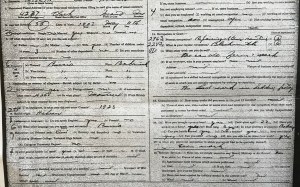
Of course, extracts aren’t cheap. Given that the cost of sending away for this record is 45$ plus tax at the time of this writing -and that is for EACH record-I don’t know that I would recommend this for everyone. It’s also important to keep in mind that the information is what the person remembers about these things in 1940, and memory is not always reliable. Information about their current job and address are fine, but information about year of immigration and where their parents were born might not be.
If you feel it’s worth the money to send away for it, you will need to know the address in 1940 of the person you are searching for. Historical directories in your area should help with that -in Quebec, it’s Lovell’s; in Manitoba, Saskatchewan and Alberta, try Henderson’s; British-Columbia has some here; Newfoundland has some here; Nova Scotia here; Ontario here; and Library and Archives Canada also has some here. Also, due to privacy restrictions, the person whose record you are seeking must be deceased for 20 years, and proof of death may be required (such as a death certificate or obituary), unless 110 years have passed since their date of birth.
I sent away for this record for one of my husband’s ancestors. Since I already had his naturalization record, this document didn’t tell me anything I didn’t already know. However, when I showed it to my grandmother-in-law, she remarked that he would sometimes get his sons to help him load up his wagon with stoves that needed repairing. This helped me to read what had been transcribed as “Repairing Sto___” to “Repairing Stoves Sometimes.” Priceless.
 Jennealogie


Leave a comment