
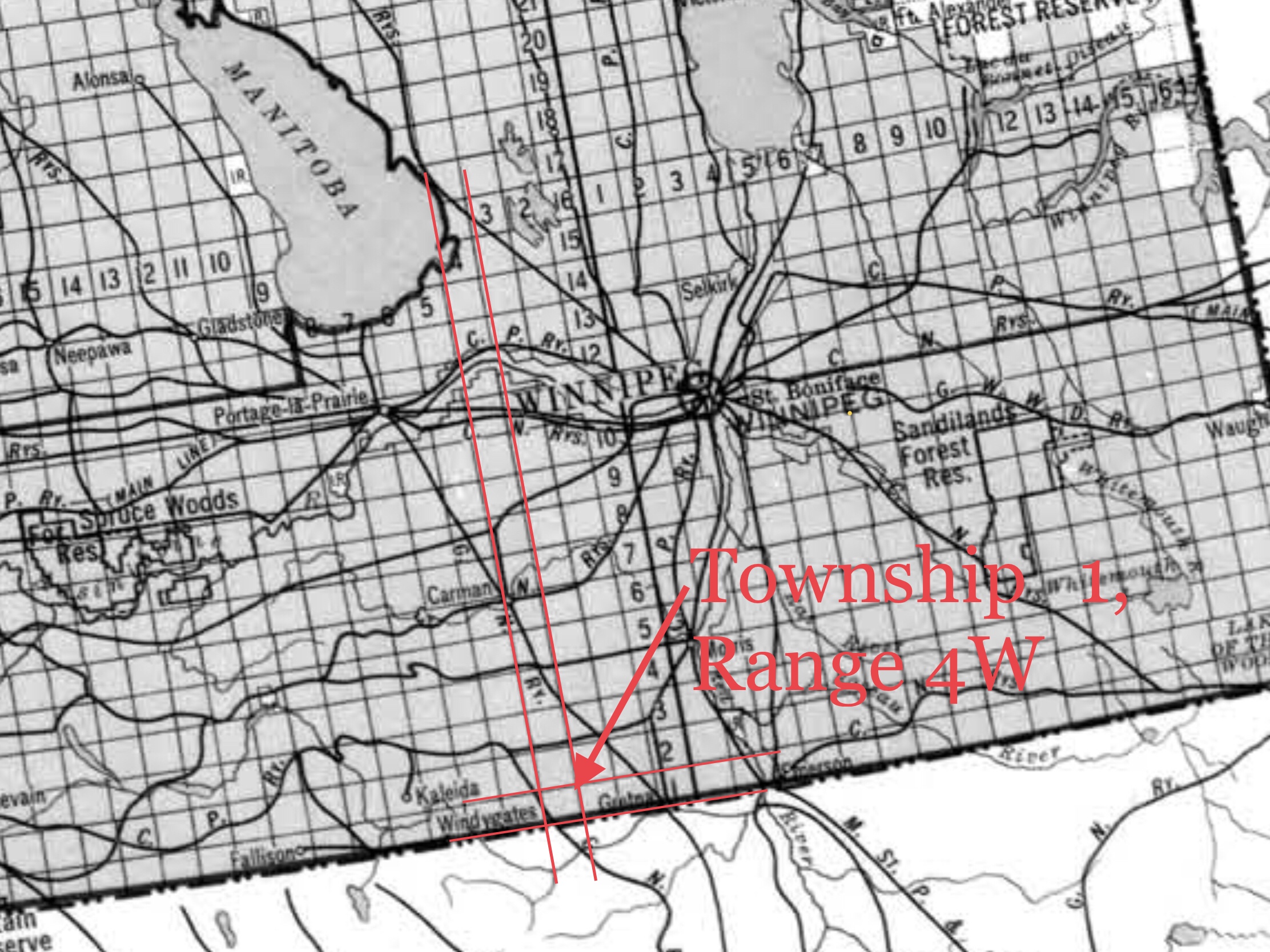
If you’re Western Canadian, you will definitely want to check out the Library and Archives Canada database Land Grants of Western Canada, 1870-1930. Using this database and other information I have, I was able to use this map to figure out where the land my ancestors owned actually is. The square in the picture is divided into 36 pieces called sections, and my ancestors farmed a quarter of one of those 36 pieces. I also highly recommend checking out this website to learn more about the township/range system.
The Application for Homestead Patent shows that in 1883, four years after beginning to homestead, a house and a stable had been built, and 48 out of the 160 acres had been farmed. Clearly this represented a lot of hard work on the part of my ancestors.
A cousin recommended I read Katarina: Mennonite Girl from Russia by Eleanor Hildebrand Chornoboy. It was a good read and I highly recommend it especially if you are Mennonite as it gives an interesting point on view of the Mennonite experience of immigrating to Canada. At one point the main character, Katarina, wonders who lived on this land before it was given to them. I too have had this question and have wondered what to make of the fact that people were displaced to make room for my ancestors.
I really liked this transcript from the CBC Saskatchewan radio show Blue Sky. On the anniversary not-guilty verdict for Gerald Stanley in the death of Colten Boushie, they had guest Michael Cappello, who teaches anti-racist education at the University of Regina, come to answer questions that the discussion had engendered. He said,
“It is surely possible to honour and respect the work and lives of the (mainly) European folks who initiated and shaped this settler-colonial state…We can honour early settlers while contextualizing the particular policies that made that settlement possible. It takes nothing away from anyone’s ancestors to tell the whole story, including the offer of cheap/free land or the peasant farming policy. That the success of European settlers in this place also required the displacement and disappearance of Indigenous people is a necessary part of telling this story in an honest way.”
I can be proud that my ancestors were invited by the Canadian government to farm, and also know that other hard-working farmers were not welcome in Canada because of the colour of their skin. I can be proud of what they accomplished while knowing that the land they paid 10$ for (the equivalent of 250$ today) is now worth a least a million dollars. It does not take away from their hard work to know that the people who were living there for thousands of years before my ancestors came were moved to make way for them. To know these things only adds to the fullness of my knowledge about my ancestors, which is the goal of any genealogist. It is, after all, a part of the Genealogical Proof Standards, the gold standard of genealogy research, that our research is exhaustive.
What is the takeaway from this? Certainly, it is not that we should feel guilty. As Professor Capello says, “guilt/blame compounds the problem.” Instead, he suggests, “It becomes important to consider how our relative positioning to the realities being discussed shape how we can hear/understand/act on the information we are being offered.” As a genealogist, I always wonder how much my ancestors and what they went through shapes who I am as a person. What I believe Professor Capello is saying here is that the knowledge of the advantages our ancestors had should also shape our understanding of the way the world works today. We can only know these things if we are open to hearing them. Finally, we must carefully consider what to do with this knowledge once we have acquired it.
I hope this is the first of many posts on what I am calling Decolonising Genealogy. I hope to learn more about decolonizing in general, and apply that knowledge to the field of genealogy. If you’re interested in decolonizing your knowledge of Canadian history, I highly recommend you start with this free online course.

 Jennealogie
Leave a comment